

It starts with “calling the child by his name” – global warming, climate disruption, and biodiversity loss is rooted in two key drivers:
- “Greenhouse gas” (GHG) emissions from
- (a) burning fossil fuels (coal, oil, gas) and
- (b) industrial meat production (beef, pork), and
- Deforestation.
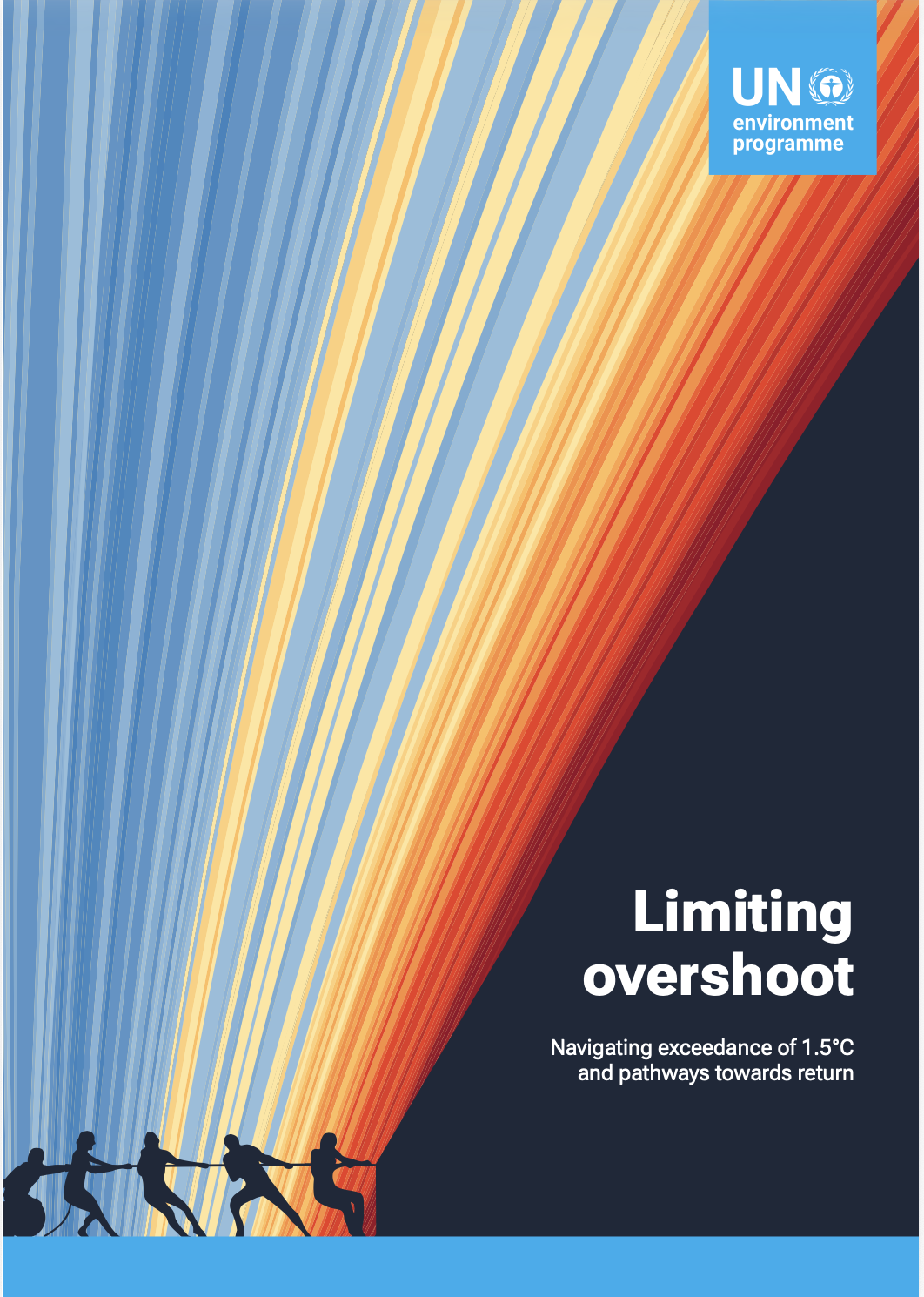
The United Nations’ official announcement1 from September 02, 2026 – which comes at least 10-years too late – that keeping global warming within the “1.5°C limit” for a stable climate failed, means concretely:
- Reducing burning fossil fuels (coal, oil, gas) – failed,
- Reducing industrial meat production (beef, pork) – failed,
- Reducing deforestation – failed, and thus
- Politics (not businesses, et al.) over the last 50 years2 – failed.
With my deepest acknowledgment to the United Nations (UN) and its organisations – led bold, passionately and wisely by António Guterres over the past years – and in my view, the greatest invention of humanity, born from the ashes of World War II: It is now time to learn and structurally change how politics – the failure is 100% political failure3 – can and will approach mitigating the root causes of climate disruption – burning fossil fuels (coal, oil, gas), industrial meat production (beef, pork), and deforestation in the future.
Failure is not the issue. But failing to learn from it – and (a) not taking the necessary consequences and (b) doing it not fast enough – would be catastrophic for potentially billions of livelihoods and lives4.
“Insanity is doing the same thing over and over again
Rita Mae Brown
and expecting different results.”
We have developed a most concrete and specific pathway for creating a healthy and thus sustainable society, starting with mitigating GHG emissions and deforestation. This new – and we strongly believe successful – way for political decision-making is based on global democracy. We strongly believe – even without the looming societal collapse from rising GHG emissions and deforestation – that this the best way forward for advancing towards a healthy and thus sustainable global governance.
We trust in the power of:
- globalised markets and trade,
- global culture and interconnectivity,
- local plurality,
- and above all, democracy – one person, one vote – no matter what income, wealth, status, skin colour, religion, gender, or age (16+).
Facing the failure to mitigate GHG emissions and deforestation, we call for extending democracy – the historically most successful concept of governance for wealth and prosperity5 – to the supranational and thus global level.
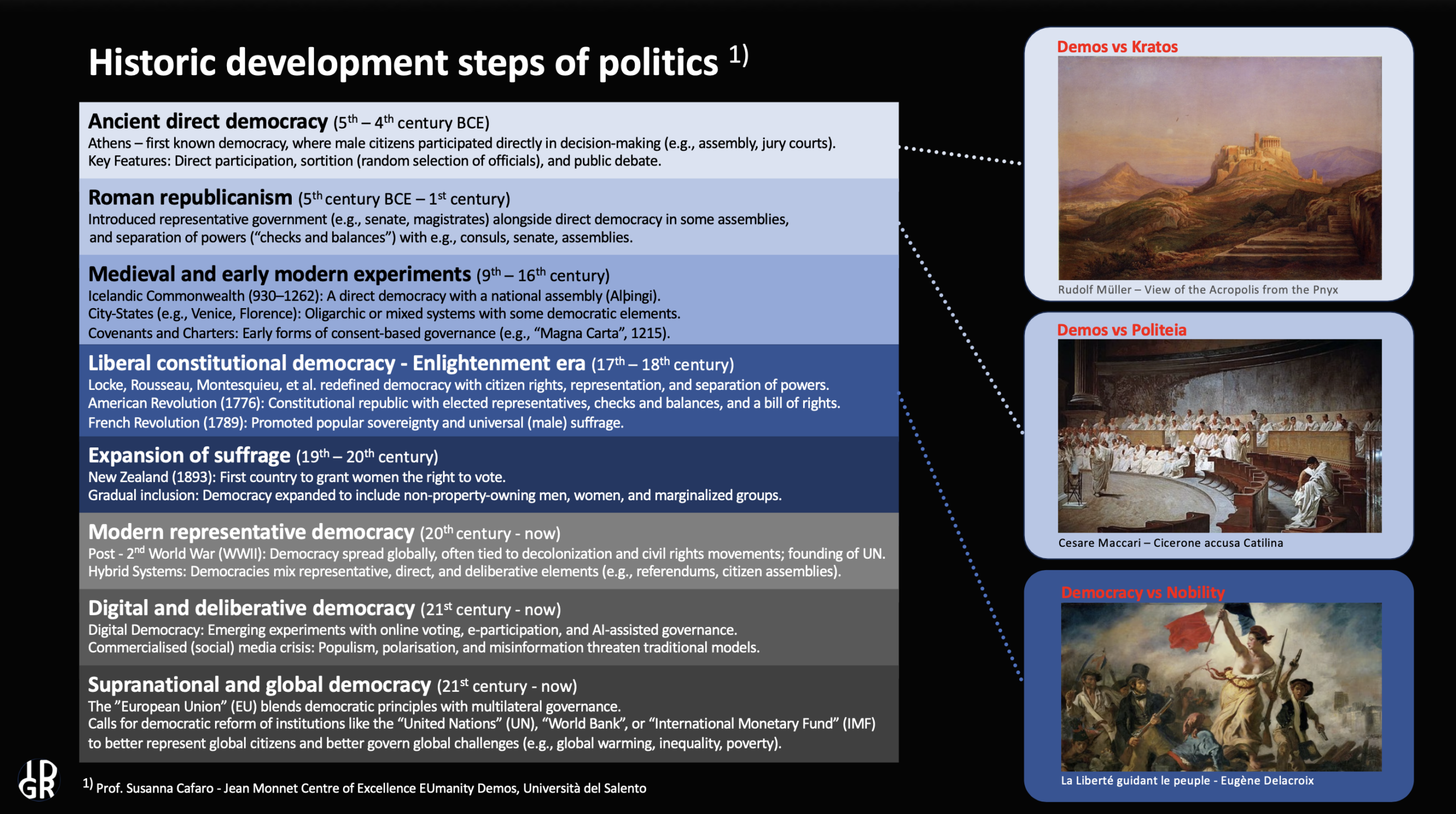
Democracy can be extended vertically by including new focus areas (e.g., including sustainability into its evaluation6) and it can be extended horizontally by leveraging it to the supranational level (e.g., the European Union, the United States of America, the United Nations).
We pledge to take the most concrete next step in global development and mitigation of global warming, climate disruption, and biodiversity loss.
With the missed “1.5°C limit” for global warming – the worst political failure in human history, in my view – and the resulting accelerating temperature rise from activated self-reinforcing cycles (most likely exponential)7, destabilising the climate system from planet Earth, we believe it is time to give the power to the people – and let them decide the future of our planet Earth.
It is time to vote now!
We call on every sitting policymaker in all 193 United Nations member states to step up and take responsibility. Now is the moment to introduce a corresponding declaration either within the United Nations Security Council (UNSC) and/or the United Nations General Assembly (UNGA) to initiate the first (and likely historic) global referendum on ‘climate action’.
This declaration will be the first step towards this global referendum – a referendum on ‘climate action’ enabling potentially 5.5 billion people – those 16+ who use the internet (about 70% of the global population 16+) – to vote easily on a simple yet critical question for the future of humanity:
Do you want stronger ‘climate action’?
YES or NO
Sources, References, and Footnotes
- cf. United Nations Environment Programme (2026): “Limiting overshoot: Navigating exceedance of 1.5°C and pathways towards return”, https://doi.org/10.59117/20.500.11822/49857 ↩︎
- cf. e.g., William D. Nordhaus published already in 1975 the fundamentals of the “1.5°C limit” for a stable climate system on planet Earth: “Can we control carbon dioxide?“. ↩︎
- It is 100% – not 80%, 90%, or 99.9% – within the obligation and responsibility of politics to ensure a healthy economy and sustainable businesses. ↩︎
- cf. Baumann, K. (2026): “How global warming will affect global population – a first theory“, IDGR.org. ↩︎
- cf. e.g., “2024 Nobel Prize supports (global) democracy“, IDGR.org: December 10, 2024. ↩︎
- cf. Campbell, D. (2026): ““Sustainable Development and Quality of Democracy: 2002–2016, Exemplified Contemporary Historical Global Model in Interdisciplinary Transdisciplinarity (New IT)“, Sustainability 2026, 18(17), 8842; https://doi.org/10.3390/su18178842 ↩︎
- cf. e.g., “Trans- and interdisciplinary global warming scenario“, IDGR.org. ↩︎
picture shows screenshot from United Nations Environment Programme (UNEP) “Limiting overshoot: Navigating exceedance of 1.5°C and pathways towards return” report cover, published September 02, 2026,
(c) 2026 UNEP.
our latest publications:
-

Article 109 Coalition, et al. UNGA81 reception underscores support for building global democracy
-

2026 Global Democracy Coalition (GDC) Forum shows strong interest in developing global democracy
-

Horizon Europe "GoGlobalClimate" project proposal submitted
-

Three CEOs just agreed AI needs to be slowed down. None of them explained who gets to decide.
-
2026 state elections in Saxony-Anhalt show significant demand for global democracy
-

Democracy Innovation – David Campbell extends our latest understanding on democracy
-

Elon Musk wants to "deal out" the global AI governance with his "buddies" from Silicon Valley in a bi-weekly call
-

2026 OPEC "World Oil Outlook" projects 20% increase in global oil demand alongside $17.7 trillion in fossil fuel investments by 2050
