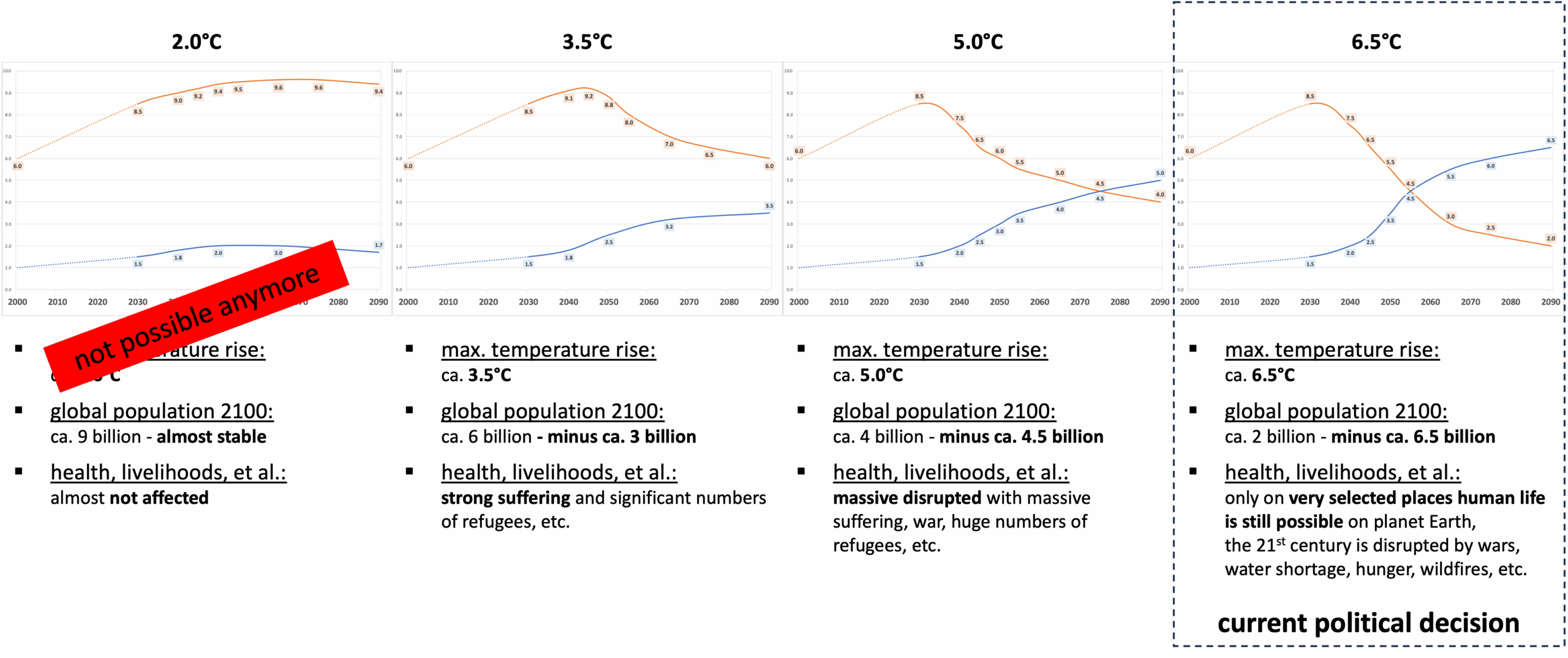
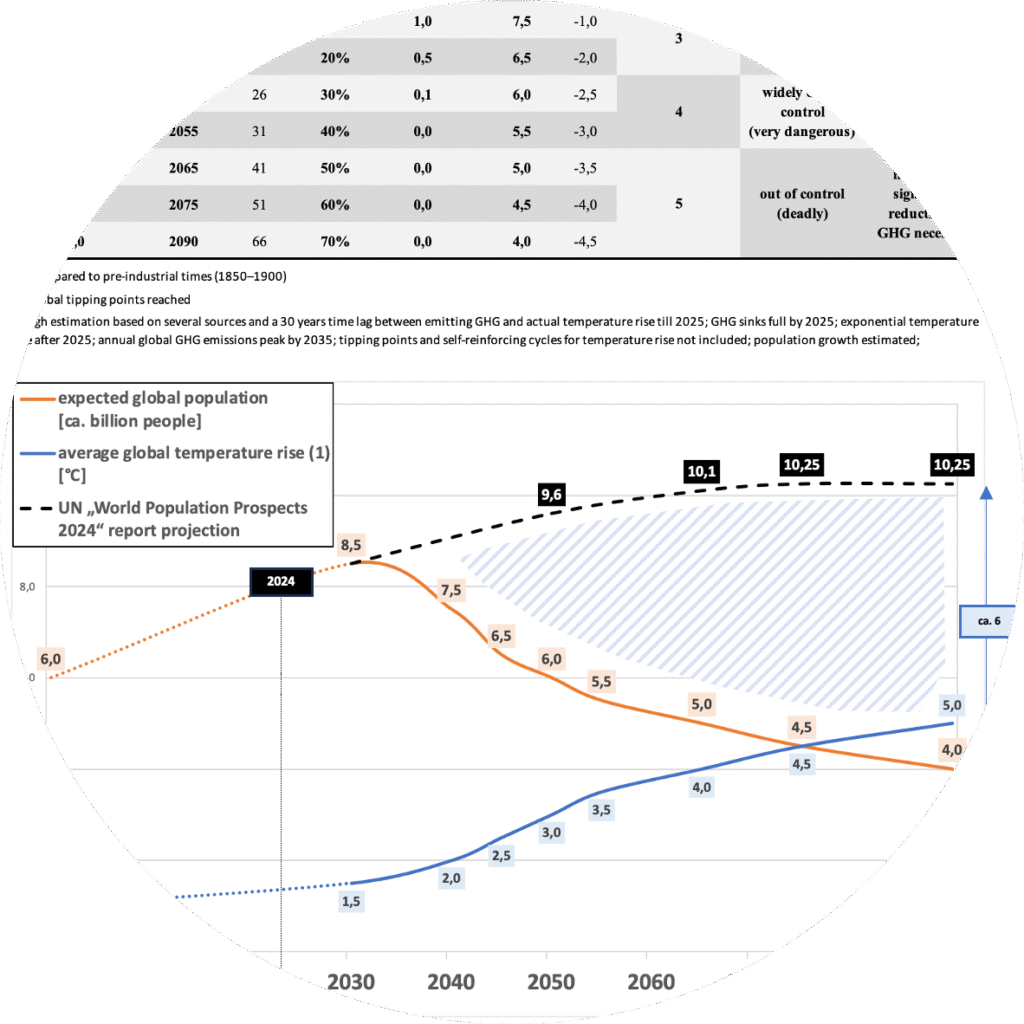
Based on my “First trans- and interdisciplinary global warming scenario” (2024), with reference to the UN “World Population Prospects 2024” report and inspired by Ugo Bardi, I developed further correlations between
- global warming, climate disruption, and the loss of biodiversity mainly due to “greenhouse gas” (GHG) emissions and deforestation
(see the blue graph in the following diagrams: average global temperature rise in °C compared to pre-industrial times 1850–1900) and - the social impacts on global population, livelihoods, and numbers of refugees
(see the orange graph in the following diagrams: expected global population in billion people).
The scenarios show the impact of political decisions with mitigating global warming till the end of the 21st century. Global warming, climate disruption, and the loss of biodiversity can be mitigated most importantly by (1) reducing GHG emissions via (1a) transforming from fossil fuels (coal, oil, gas) to zero-emission energy supply and via (1b) transforming from industrial meat production to healthy global nutrition and by (2) reforestation.
Research outlook
To further elaborate the scenarios, I wish and recommend to go into a (trans- and interdisciplinary) process with a plural group of scientists from various research areas based on the “Delphi methode“.
Every quantitative methodology is limited and reductive, since quality, complexity, system dynamics, language, and emotions can only be measured to a limited degree. The act of measurement in itself is an interception with the system it wants to measure. So, the measurement can never be neutral (cf. e.g. Karl Baumann: Zur Wertigkeit von „gut“ und „schlecht“, Carl-Auer Publishing 2002).
The core, first and most important step within science remains to ask the relevant questions. Human cognitive abilities are unprecedented, especially when collaboratively connected within trans- and interdisciplinary research organisations (e.g. as a “team” within a “project”).
Science (incl. social & natural sciences) degraded by “positivism” to numbers, figures, and statistics. Paradoxically, with trillions of dollars, we now invent “Artificial Intelligence” (AI) – an absurd term – to reinvent thinking.
This methodology was used by humans and is called a “heuristic approach”. This “heuristic approach” (and with it all qualitative methodologies) degraded and almost vanished within the context of “positivism research” and quantifying methodology delivering quick wins and easy solutions. But, Karl Popper‘s framework never proofed to perform on complex and dynamic systems and never delivered long-term prosperity.
I am looking forward to AI, High-performance and Quantum Computers supporting this research. Nevertheless and most important, it remains to us humans, to ask the machines the relevant questions to deliver on healthy political decision making.
Related research
- Bardi, U. (2026):
The End of Population Growth: Reaching Humankind’s Planetary Limits
A Report to The Club of Rome, Club of Rome, Winterthur
- Min, J., Li, H., Nagler, T., & Li, S. (2025):
Assessing climate-driven mortality risk: A stochastic approach with distributed lag non-linear models
arXiv preprint arXiv:2506.00561
- Romanello, M., Walawender, M., Hsu, S. et al. (2025):
The 2025 report of the Lancet Countdown on health and climate change: climate change action offers a lifeline
The Lancet, 2025; 406, 2804-2857
- Xu, C., Kohler, T.A., Lenton, T.M., Svenning, J. & Scheffer, M. (2020):
Future of the human climate niche
Proc. Natl. Acad. Sci. U.S.A. 117 (21) 11350-11355
- and many others more
our research focus:

focus one
The new healthy global society

focus two
The new healthy global economy

focus three
Global democracy & healthy technology
latest research papers: