
What does “healthy” really mean?
“Health” is the foundation of everything: happiness, satisfaction, joy, love, and the kind of society worth living in. It is more than the absence of disease. The “World Health Organisation” (WHO) understood this when it defined “health” not merely as physical wellbeing, but as a state of complete physical, social, and mental wellbeing. And right now, by that measure, our world is unwell.
The world is struggling
And yet, the world we live in is struggling not because human beings are incapable of doing better, but because the systems we have built to govern ourselves have not kept pace with the challenges we face. Temperatures are rising, biodiversity is collapsing, inequality is widening and communities are fracturing. People are more stressed, more isolated, and more disconnected from one another than at any point in recent times. These happenings are the predictable outcomes of a global system that has never been designed to serve the wellbeing of people or planet but only to maximise profit.
A society worth living in
So what does a “healthy society” actually look like? It is one where people are not just surviving but thriving. Where physical wellbeing is supported by a clean environment and access to natural resources, where social wellbeing is nurtured through genuine connection, collaboration, and solidarity, and where mental wellbeing is fed by creativity, purpose, and the freedom to think and act. A “healthy society” is, in the simplest terms, a happy, joyful, satisfied, and beloved one.
And a “healthy society” is, by definition, a sustainable one. Why? Because sustainability is not a separate goal to be pursued alongside health. A society that genuinely protects the physical, social, and mental wellbeing of its people will not do things that harm itself, others, or the environment within which it exists and depends on. Sustainability is the natural outcome of a “healthy society”.
This belief is not utopian. It is a possibility when the systems governing our lives are designed around the human and planetary wellbeing rather than extraction and exploitation. A “healthy society” lives in harmony with its natural environment rather than depleting it. It builds economies through creativity and cooperation rather than exploitation, economies that are plural, diverse, and accountable to the people they serve rather than concentrated in the hands of a few; and it finds the balance between economic activity and the conditions that allow both people and nature to flourish.
But health at this scale does not happen by accident. It requires governance that is accountable to the people that it serves. And that, ultimately, is the case for democracy; not as an abstract ideal, but as the practical prerequisite for a healthy and thus sustainable global society. This is where the current system fails us.
The economy is already global. Companies operate across borders, moving capital and production to their preferred and most conducive environments. The result is a race to the bottom. Nations compete to offer the lowest taxes, the weakest regulations, and the most accommodating conditions for capital that owes allegiance to no flag and no people. The costs of that race – which are environmental, social, and economic – are borne by everyone, with the benefits concentrated in the hands of only a few.
Power without accountability
And yet the political systems tasked with addressing this remain largely national. Supra-national institutions exist, but they lack either the power or the democratic legitimacy to act at the scale our current crisis demands. In that vacuum, power has quietly shifted away from the people – the “sovereign”, to representatives and international corporations that answer to no electorate and no common good.
Humanity has been here before
The “Second World War” broke the world again, but out of that destruction emerged the “United Nations” (UN), another attempt by humanity to govern itself collectively. It was an imperfect institution, but it was a historic one. It represented a moment where humanity decided to build something new for their common good.
We find ourselves in a similar situation now. The data from the IPCC is unambiguous. The mimetic forces: greed and competitive consumption that have driven us to this point will not self-correct. They never have. What has always been required is a strong, democratically accountable system which needs to operate at the global scale.
The biggest step in human history
IDGR believes this moment carries within it the same historic potential as the post-war period; perhaps even greater. We are calling for a “Global Democratic Republic” rooted in the “Universal Declaration of Human Rights” and governed on the principle of one person, one vote (global democracy). The “Global Democratic Republic” would establish the structures that current global governance currently lacks. A democratically elected global legislature, a global tax system, justice institutions with genuine reach and legitimacy, and critical independent global media and journalism, financed through that same global tax system free from the influence of corporate or national interest, and capable of strengthening democratic discourse across the globe.
The technology to make this possible already exists. The internet, smartphones, and digital infrastructure have created the conditions for genuine global democratic participation in a way that was unimaginable a generation ago. The barrier is no longer technical. It is political will.
It starts with us
A Global Democratic Republic is not something that will be handed down from existing power structures. It will be built from the ground up, by people who understand that the challenges we face are too big for any one nation to solve alone, and who are willing to imagine, demand and work for something bigger, better and more impactful.
IDGR believes that a “healthy society”, one that is happy, satisfied, and beloved is not a utopian dream. It is what becomes possible when we build governance structures that serve people and planet rather than extract from them.
The question now is not whether a “Global Democratic Republic” is possible. It is whether we will have the courage to build it before the cost of not doing so becomes irreversible.
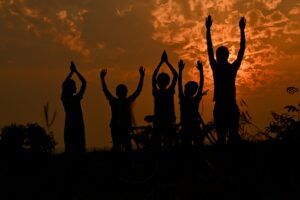
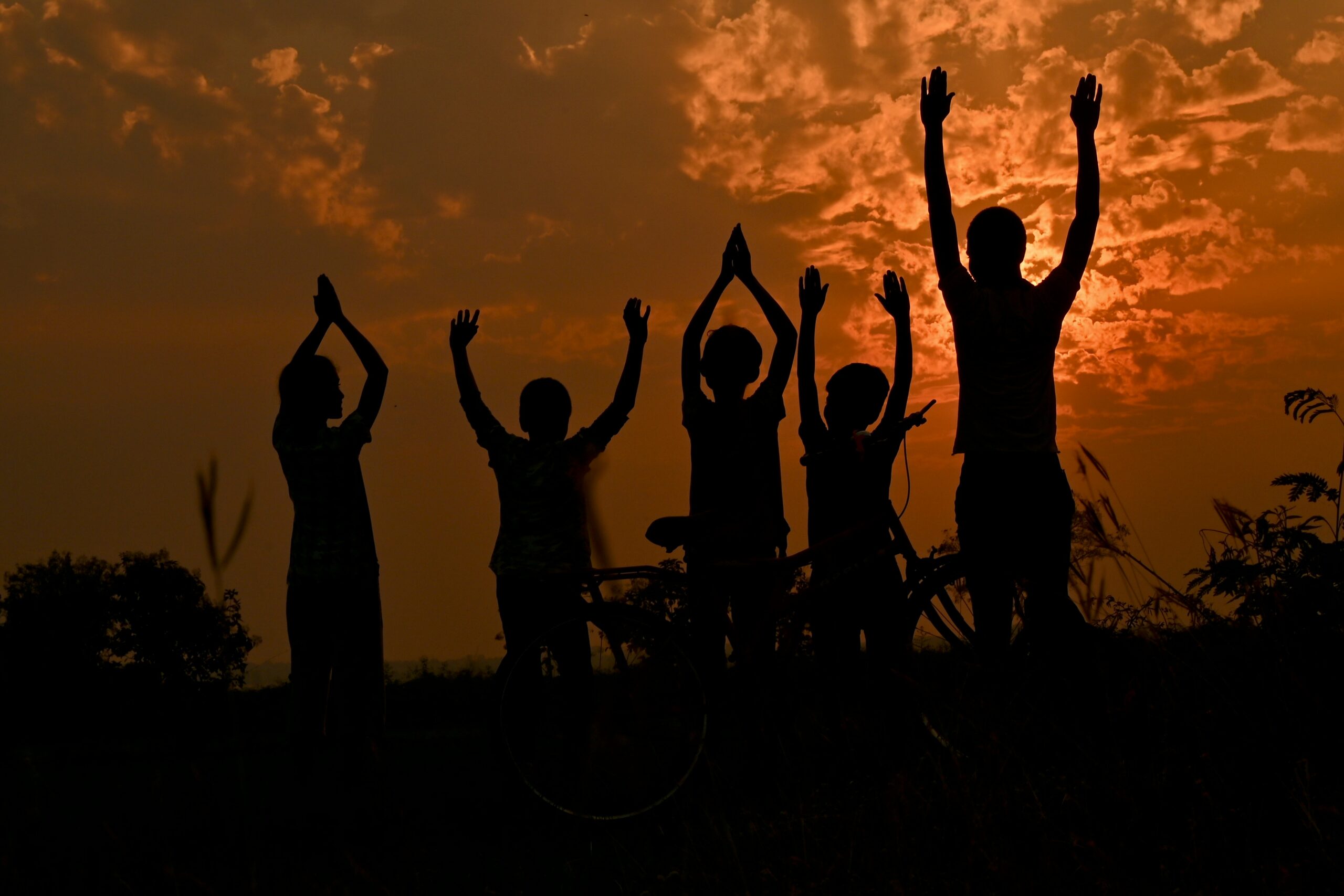
picture (c) 2020 Rajesh Rajput shows children enjoying the sundown.
Source: unsplashed.com
our research focus:

focus one
The new healthy global society

focus two
The new healthy global economy
focus three
Global democracy & healthy technology
latest research papers: