

We have a dream: Just one day without any armed conflict on our planet Earth. Do we need more and/or better, or less and/or no weapons to actually realise this dream?
Reading “The Ankara Summit Declaration” from July 08, 2026 – the official final text from the 2026 “North Atlantic Treaty Organization” (NATO) summit in Ankara – there is a clear answer: yes, NATO states that significantly more and better weapons are the answer and necessary.
We are back to the “Cold War” scenario, but this time it is a global arms race
NATO intends to significantly increase spending for military (weapons, et al.) to 5% of GDP and understands this as “success” and “progress for humanity”.
Already in the 2025 NATO summit in The Hague, the alliance committed to increase its spending into “360° deterrence and defence” to 5% of “Gross Domestic Product” (GDP) within each single member state (cf. NATO: “Defence investment and NATO’s 5% commitment“, June 29, 2026).1
“Our unity, solidarity and collective strength remain the foundation of peace, security, and prosperity for the one billion citizens in our Alliance of free and democratic nations. We remain committed to our 360-degree approach to deterrence and defence.”
NATO: “The Ankara Summit Declaration“, Point 1, July 08, 2026
The “Stockholm International Peace Research Institute” (SIPRI) reports a record global military expenditure of ca. $2,887 billion (or ca. $2.9 trillion) p.a. for 20252.
“Average military expenditure (% of GDP) deteriorated for the third consecutive year and is now at its highest level since the inception of the Index. There were 96 countries where relative military spending increased, compared with only 44 where it decreased.”
Global Peace Index 2026 3
We as humanity spend about 60 times more on military (weapons, et al.) – ca. $2.9 trillion – than on peace – ca. $49 billion – per year
Looking in comparison, how much do we spend as global society into peace-building and peace-keeping, human rights development, international law strengthening, and global health promotion, we might look into the overall budget of the “United Nations” (UN) – which was ca. $69 billion in 20244. Alternatively, we might look more specifically into the global expenditure on peace-building and peace-keeping – which was ca. $49.2 billion in 2025.
“Expenditure on peacebuilding and peacekeeping was US$49.2 billion in 2025, just 0.5 per cent of total military spending in purchasing power parity (PPP) terms.”
Global Peace Index 2026 5
Based on current data from the “International Monetary Fund” (IMF), the overall global GDP6 was ca. $118 trillion for 2025. Comparing the overall spending on “military” with that on “peace-building & peace-making” against the overall global “GDP” reveals an utmost significant gap. While we as humanity spend ca. 2.44% of global GDP on “military (weapons, et al.)”, we only spend ca. 0.04% of global GDP on “peace (building, keeping, et al.)” (see the following graph).
![(c) 2026 IDGR: Overall global spending comparison in [%] of global GDP](https://idgr.org/wp-content/uploads/2026/07/20260713-Overall-spending-globally-in--scaled.jpg)
UN budget of 0.1% from global GDP would double the current UN budget for peace-building & peace-keeping
While NATO is increasing its spending on “360° deterrence and defence” to 5% of (national) GDP, the spending for all the UN organisations remains ca. 0.06% of (global) GDP.
For example, during the period after “World War II” and the so-called “Cold War” phase, it was absolutely clear: there is a vicious cycle – more and/or better weapons lead to more and/or better weapons, which increases the likelihood, disruption, and potential devastation of hostile conflicts and wars using these increasingly advanced weapons. This clear understanding among leaders and decision-makers at that time – certainly most influenced by the terrible experiences of “World War II” – paved the way towards the “Cold War” arms control framework.7
And no, more and/or better weapons is certainly not what we want to have on our planet Earth or what I would understand as “success” or “progress for humanity”. Personally, I have never understood the concept of “war for peace” or “weapons for conflict resolution”.
Let us invest 0.05% of global GDP in the development of global democracy
Peace is the path and demands a continuous investment in education, dialogue, diplomacy, and negotiations. Democracy has historically proven most successful in delivering peace and prosperity8, based on democratically developed and thus grassroots-legitimised legal frameworks, operated by strongly institutionalised organisations with a clear “separation of powers” (e.g., checks and balances).
We have developed these structures and processes most successfully at the national level. Now, it is time to develop them at the global level. We call this the development of a “Global Democratic Republic” and we understand such a development as the most impactful action towards global peace and prosperity.
NATO can contribute to that historic development by shifting its priorities from a “fighting perspective” to a “health promotion perspective”. NATO certainly has the potential to lead the global community – comprising not only their member states but all 193 UN member states – towards a kind of “Global Peace Alliance”, embedded within a “Global Democratic Republic”.
This would certainly demand creative, bold, visionary, and historic leadership – a leadership that rests on authenticity, sustainable values, inner strength, strong self-esteem, balanced emotions, and discerning judgment, rather than inferiority and “mimetic forces” such as greed, vanity, envy, jealousy, and group-think.
A leadership with an understanding of “love” as a concept and skill, including not only oneself, one’s family, friends, and like-minded but the entire currently 8.1 billion people living on our wonderful planet Earth. This kind of leadership would embrace all their plurality and promote “Make Planet Earth Great“.
“There is no Christian, no Muslim, no Jewish blood. There is only human blood. I say, be human!”
Margot Friedländer (1921-2025)
References
- cf. NATO: “FACTSHEET – NATO defence spending percentage GDP“, February 2024 ↩︎
- cf. SIPRI: “Global military spending rise continues as European and Asian expenditures surge“; April 27, 2026 ↩︎
- Institute for Economics & Peace (IEP): “Global Peace Index 2026: Identifying and measuring the factors that drive peace“, p. 4; Sydney, June 2026 ↩︎
- cf. e.g., Dag Hammarskjöld Foundation: “Financing the UN Development System: Managing Unprecedented Times“; September 2025 ↩︎
- Institute for Economics & Peace (IEP): “Global Peace Index 2026: Identifying and measuring the factors that drive peace“, p. 5; Sydney, June 2026 ↩︎
- cf. IMF Datamapper: “GDP, current prices 2025” (imf.org/external/datamapper) ↩︎
- cf. e.g., Council on Foreign Relations: “U.S.-Russia Nuclear Arms Control” ↩︎
- cf. e.g., Karl Baumann (2024): “2024 Nobel Prize supports (global) democracy” ↩︎
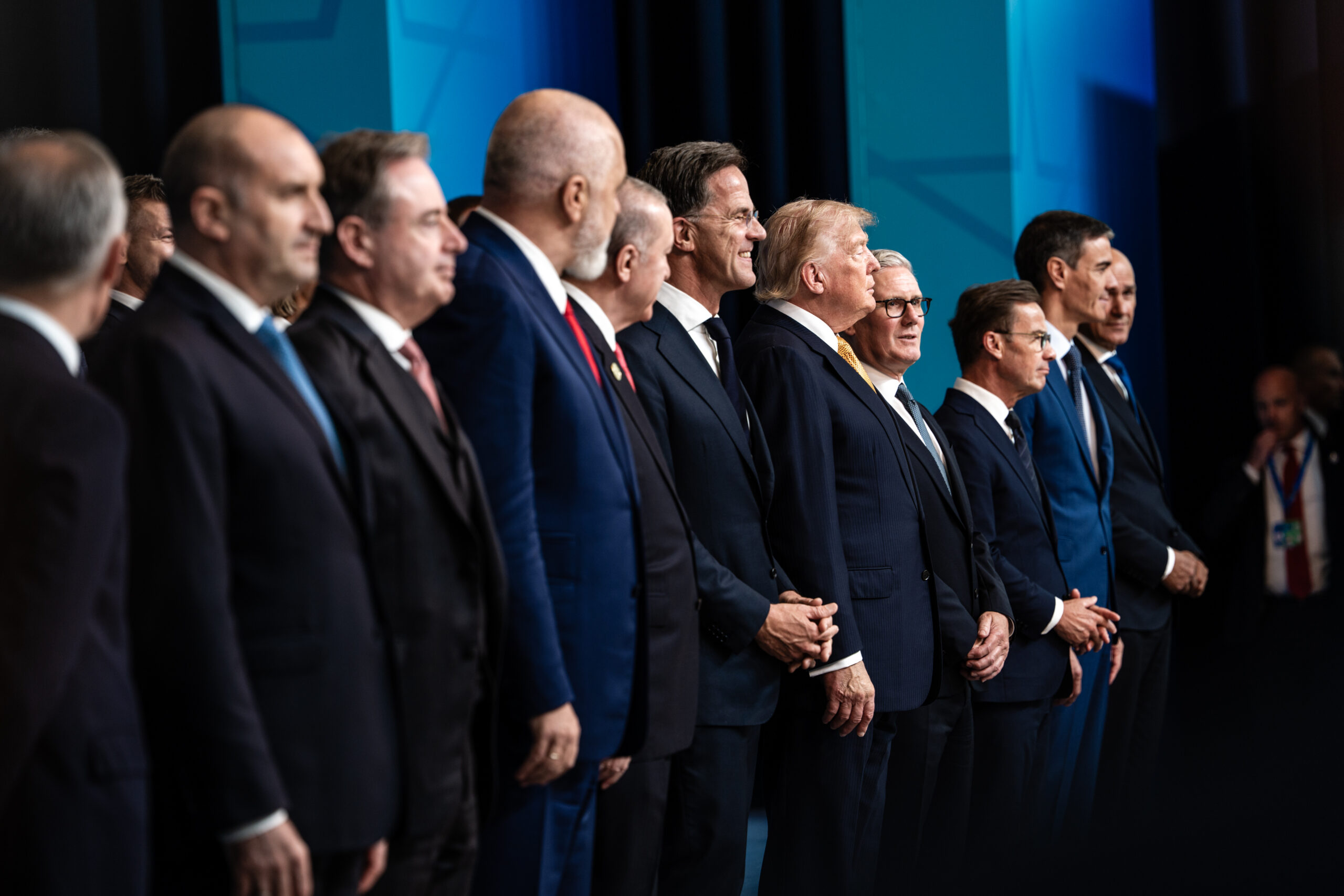
picture shows official photo of NATO Heads of State and Government – 2026 NATO Summit in Ankara, July 07-08, 2026.
(c) 2026 NATO.
our latest publications:
-

The Way into a first official Global Referendum on 'Climate Action' with potentially 5.5 billion People in the age 16+
-
Article 109 Coalition, et al. UNGA81 reception underscores support for building global democracy
-
2026 Global Democracy Coalition (GDC) Forum shows strong interest in developing global democracy
-

Horizon Europe "GoGlobalClimate" project proposal submitted
-

Three CEOs just agreed AI needs to be slowed down. None of them explained who gets to decide.
-
2026 state elections in Saxony-Anhalt show significant demand for global democracy
-

UN officially admits: Reducing burning fossil fuels (coal, oil, gas), meat production (beef, pork) and deforestation failed. It is time to vote.
-

Democracy Innovation – David Campbell extends our latest understanding on democracy
