Global average temperature rise has reached ca. 1.4°C in 2023 (cf. e.g., WMO, Copernicus, NOAA) and shows a time lag of ca. 30 years between the emission of the GHG and the actual temperature rise (for “climate lag” see following graph based on graphs from “Our World in Data“). GHG sinks like the ocean, the terrestrial surface (e.g., forests, plants, and soil), and the atmosphere were able to delay the temperature rise.
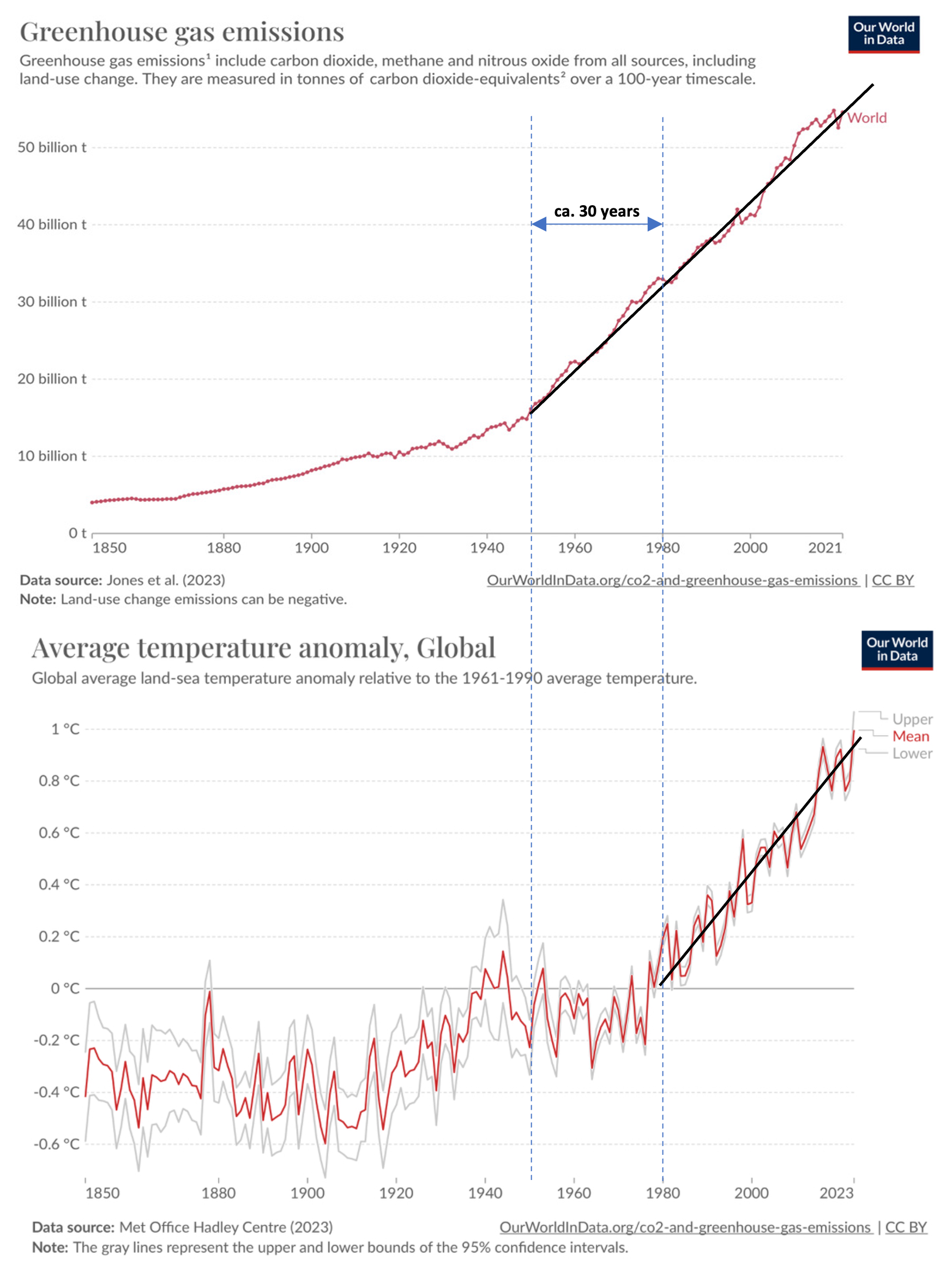
Based on that, we already emitted enough GHG into the atmosphere of our planet Earth to have a global average temperature rise of at least 2.2°C till ca. 2050 (in comparison to the global average between 1850-1900) with a very optimistic linear projection.
Since the GHG sinks seem to be full (cf. e.g., ocean temperatures are rising), annual GHG emissions where not stable within the last 30 years (significantly increasing ca. 42%), the time lag between emitting the GHG and the temperature rise will shorten, and the temperature increase caused by the GHG emissions within the last 30 years will most likely impact global warming, climate change, and the loss of biodiversity significantly more than previous 30 years. We expect an exponential increase.
This means, climate “tipping points” (cf. e.g., McKay, et al.) will be reached, and unstoppable global warming self-reinforcing cycles activated (e.g., burning forests emitting additional GHG which leads to additional temperature rise and this leads to additional burning forests). Thus, global warming, climate change, and the loss of biodiversity is in our view already within the status of “partly out of human control”.
our research focus:

focus one
The new healthy global society

focus two
The new healthy global economy

focus three
Global democracy & healthy technology
latest research papers: