

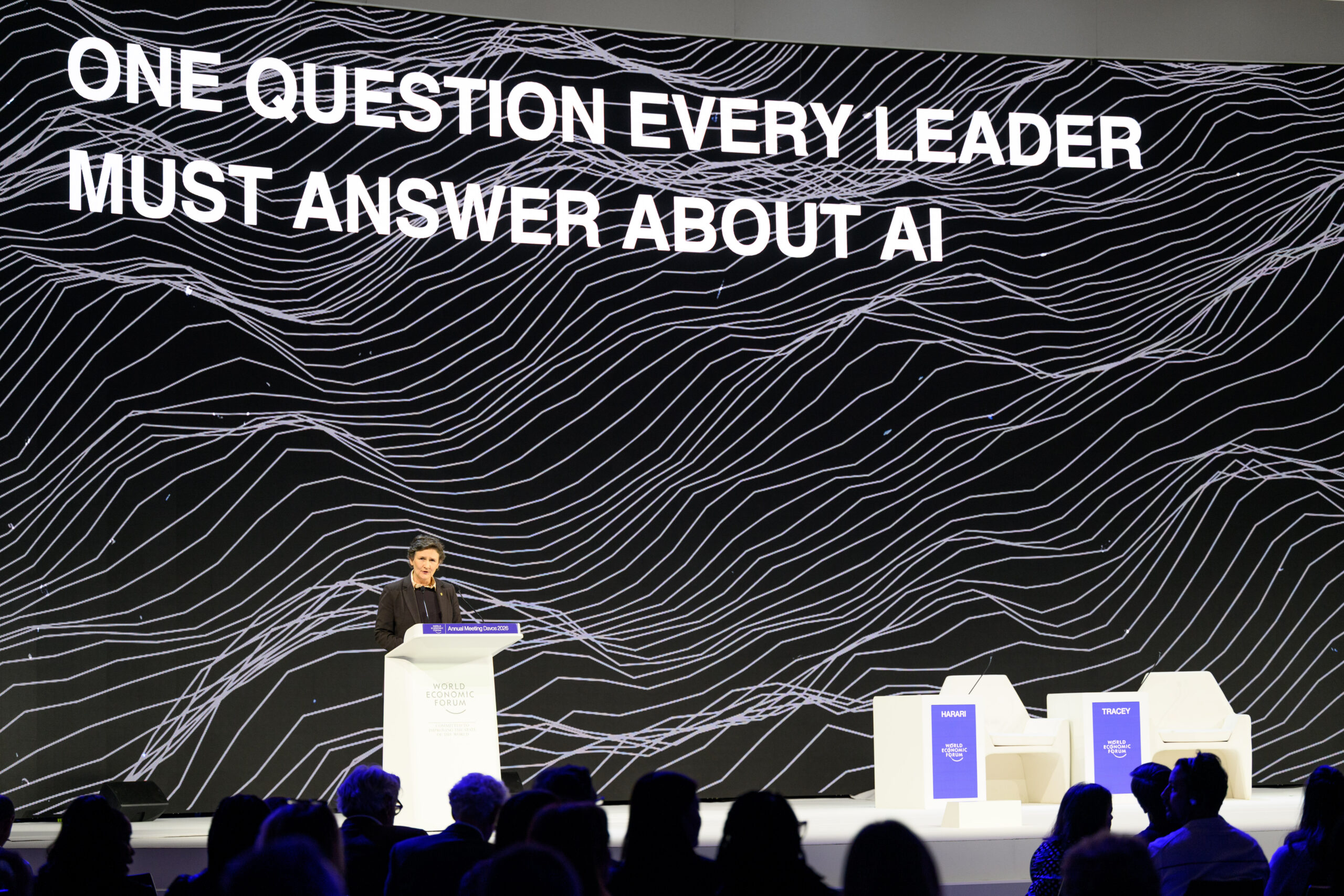
From January 19–23, 2026 the leaders of notable global corporations met with global political leaders at the World Economic Forum Annual Meeting – A Spirit of Dialogue in Davos, Switzerland.
Despite highly acknowledged debates and discussions (most of which can be viewed online), the forum missed to focus on the current most important topic for human prosperity – mitigating greenhouse gas (GHG) emissions, global warming, climate disruption, and the loss of biodiversity (cf. Trans- and interdisciplinary global warming scenario).
If anything, mitigating GHG emissions is too big to fail
Money – the strongest steering and controlling instrument in our current societies – and global markets, are some of the human inventions, that have enabled humanity’s progress over the last 80 years (e.g., COVID-19 tested global supply chains and they remained impressive resilient).
Money and global markets – core topics of discussion within the World Economic Forum (WEF) – are also the kind of inventions, which have enabled the upcoming global (societal) collapse, much faster than most can even imagine. Starting with the insurance industry, infecting the banking industry and eventually pushing the current financial system beyond its limits.
Every scientist who is radically honest about this evidence will arrive at the same conclusion. Latest global politics (e.g., from the U.S. Trump administration) is accelerating this collapse. Despite this, the speech from Mr. Donald J. Trump at the 2026 WEF drew an applause and even a standing ovation. Given the focus on money and short-term profit maximisation, this is unsurprising, as short-term profits can be maximsed by accelerating fossil fuel exploitation (coal, oil, gas).
The World Economic Forum is compromised
There is a huge “Elephant in the room” with the World Economic Forum (WEF). It is the mimetic forces: greed, vanity, envy, jealousy and group-think.
Wherever more money is involved, the stronger the mimetic forces. This is the deadly self-reinforcing cycle from “Economic liberalism” Adam Smith preached. The WEF is all about money, wealth, and power maximisation. Whoever thinks about the WEF in a different way, may not be aware of the role of the strongest steering and controlling instrument in our current societies – money.
Many agree that, to maximise profits, you first of all have to be greedy. Performance, competition and success are the formula for profit maximisation. There are several appealing euphemisms for “greed”, like “ambition”, “performance”, “innovation”, “being target-oriented” or “focused”. However, in a commercialised context, they all mean “greedy actions” at the end of the day. Within this context, greed is portrayed as something good. It is wanted, applauded, and it becomes the source of a prospering economy and therefore, a prospering society.
Mimetic forces are the root-cause of the upcoming social collapse
The social and behavioural root cause of the greatest threat currently plaguing humanity – the emissions of GHGs into the atmosphere of the planet, is based on mimetic forces, most notably greed. The exploitation of coal, oil, gas and industrial meat production yields trillions of profits every year and the top 20 global corporations (no matter what kind of metric used) are dominated by corporations from the fossil fuel and food industry.
Fossil fuel and industrial meat producing corporations are doing what they are designed to do – maximising profits – no matter how it is framed, whether as a “Return on Investment” (ROI), “Economic Value Added” (EVA)” or “Shareholder Value” (SV) etc. Energy and nutrition is vital to our daily lives and the aim of these corporations is to maximise demand for their products which drives the wealth of their corporations.
In profit oriented corporations “Corporate Social Responsibility” (CSR) or “Ethics” are “good ” as long as the consumers seek them, and as long as CSR or ethic actions are contributing to cost efficiency and profit maximisation.
The state-of-the-art (economical) questions are beyond societal collapse
Based on that economic understanding, the question is no longer, whether there will be “(societal) collapse“. We are already headed there with global warming already out of human control.
The relevant questions we should be asking are:
- What are the reasons for this upcoming collapse?
- How can we invent a global society to deal with the collapse in the best possible way?
- How can we develop a healthy and thus sustainable global society?
- How can we develop a new healthy global economy?
Unfortunately, during the 2026 WEF, these kind of questions were largely absent or peripherally addressed. The focus and thinking of the current global leaders and decision makers do not seem to be there yet. This is not surprising, since the current political and business decision making processes are structured around short-term incentives. Moreover, current temperature rise shows a lag of about 30 years and therefore, these leaders do not perceive urgency of this matter even though millions of lives have already been negatively affected.
Business leaders and decision makers are primarily focused on their short term cost efficiency and profit maximisation efforts (e.g., via “artificial intelligence”). Meanwhile politics has been reduced to a passive observer, since there are no strong global political structures for legislation, enforcement and justice capable of effectively governing international corporations.
We are very confident that the “World Economic Forum” (WEF) understands these complex correlations and develops accordingly.
picture shows photo from 2026 World Economic Forum: Scene from “An Honest Conversation on AI and Humanity” session with Yuval Noah Harari, Distinguished Research Fellow, Centre for the Study of Existential Risk; Irene Tracey, Vice-Chancellor, University of Oxford; at the “World Economic Forum Annual Meeting 2026” in Davos-Klosters, Switzerland, on 20/1/2026 from 14:30 to 15:00 in the Congress Centre – Congress Hall (Zone C), Plenary;
(c) 2026 World Economic Forum (WEF).
our latest publications:
-

The Way into a first official Global Referendum on 'Climate Action' with potentially 5.5 billion People in the age 16+
-

Article 109 Coalition, et al. UNGA81 reception underscores support for building global democracy
-

2026 Global Democracy Coalition (GDC) Forum shows strong interest in developing global democracy
-

Horizon Europe "GoGlobalClimate" project proposal submitted
-

Three CEOs just agreed AI needs to be slowed down. None of them explained who gets to decide.
-
2026 state elections in Saxony-Anhalt show significant demand for global democracy
-

UN officially admits: Reducing burning fossil fuels (coal, oil, gas), meat production (beef, pork) and deforestation failed. It is time to vote.
-

Democracy Innovation – David Campbell extends our latest understanding on democracy
