Every April 22, the world remembers – very politely – that it still has a planet. It is a predictable annual ritual: announcements, speeches, hashtags, green logos, recycled promises, and a sudden burst of environmental concern that lasts exactly as long as the event coverage. Then everything returns to normal, which is to say, environmentally unstable.
In 2026, “Earth Day” arrives under the theme “Our Power, Our PlanetTM”. A powerful phrase; almost convincing if you do not look at the results.
We are told repeatedly that we have “power.” Collective power; youth power; policy power; corporate responsibility power; green transition power.
And yet somehow, that power behaves like a missing remote control, everyone insists exists. Nobody can find it, and the batteries are always “coming soon.”
The irony is now fully mature: we keep declaring power over a planet we are steadily destabilizing. A powerful planet, apparently, but increasingly behaving like a planet under pressure from its most confident inhabitants.
The truth is simple enough that it no longer needs scientific translation
We know what is happening, we have known for decades. The data is not missing, the warnings are not unclear, and the solutions are not unknown. What we lack is not understanding, it is consistency, accountability, and anything that resembles follow-through.
“Earth Day” began in 1970 as a disruption. It was anger made visible. Smog, poisoned rivers, oil spills and a public that had run out of patience. It forced governments to react. And for a moment, that reaction looked like progress: laws were passed, agencies were formed, and environmental protection became a serious political subject.
Then the system adapted
“Earth Day” survived by becoming harmless. What was once protest became programming. What was once urgency became ceremony, and what was once a demand became a yearly reminder that we already agreed the problem exists.
Fast forward to 2026, and “Earth Day” is no longer a warning it is a routine. Over 190 countries participate, which sounds impressive until you realize participation is not the same as transformation. Trees are planted while forests are cleared elsewhere at industrial scale. Climate commitments are announced with precision in language and flexibility in enforcement. Corporations speak the vocabulary of sustainability fluently while operating systems built on extraction and expansion.
It is no longer a question of awareness. It is a question of performance quality.
We have mastered the art of looking concerned
The phrase “Our Power, Our PlanetTM” suggests control. But control over what exactly? Because if this is control, it comes with unusual side effects: rising emissions, accelerating biodiversity loss, ocean warming, and increasingly frequent declarations that “urgent action is needed” delivered at events that are anything but urgent in outcome.
Power is not missing in this story. It is fully present. It sits in governments that approve expansion while promising reduction, in corporations that redesign branding faster than infrastructure and in global financial systems that can mobilize trillions instantly just not in the direction of long-term ecological stability.
So, the problem is not absence of power – it is direction of power
The uncomfortable truth is, “Earth Day” often circles but rarely states directly that the systems driving the crisis are not failing. They are functioning exactly as designed. Designed for growth, extraction, consumption, and short-term stability, rather than planetary balance.
Which is why every year produces the same outcome dressed in different language. More awareness, reports, commitments and an exceedingly wide gap between what is said and what is done.
If “Earth Day” were honest in 2026, its report card would need no interpretation:
- Understanding the crisis: Fully developed
- Ability to describe the crisis: Excellent
- Ability to act on the crisis: Continuously postponed
- Alignment with reality: Missing
We do not lack intelligence and technology. We do not even lack global coordination frameworks. We lack the willingness to let systems feel the consequences of what they already know and the damage they are causing.
Instead, we maintain a carefully balanced contradiction, a world that acknowledges ecological limits while structurally operating as if they do not apply.
And the planet, of course, does not participate in this contradiction. It does not attend conferences, neither does it read policy briefs nor adjust according to political cycles. It responds. Slowly at first, then unmistakably.
So when “Earth Day” 2026 says “Our Power, Our PlanetTM“, it almost sounds like confidence. But it also sounds like a question that keeps being answered incorrectly. Because yes, we have power, and yes, we have a planet……for now.
The huge gap between our declarations and actions is where the entire story of failure quietly sits. Not in ignorance, nor in absence of warning, but in repetition without correction.
Earth Day does not need more celebration
It does not need more branding. It does not even need more awareness. It needs the one thing the world keeps scheduling for later: “Change that actually disrupts the cycle”.
Until then, “Earth Day” will continue to return each year: polished, global, and increasingly difficult to mistake for impact.
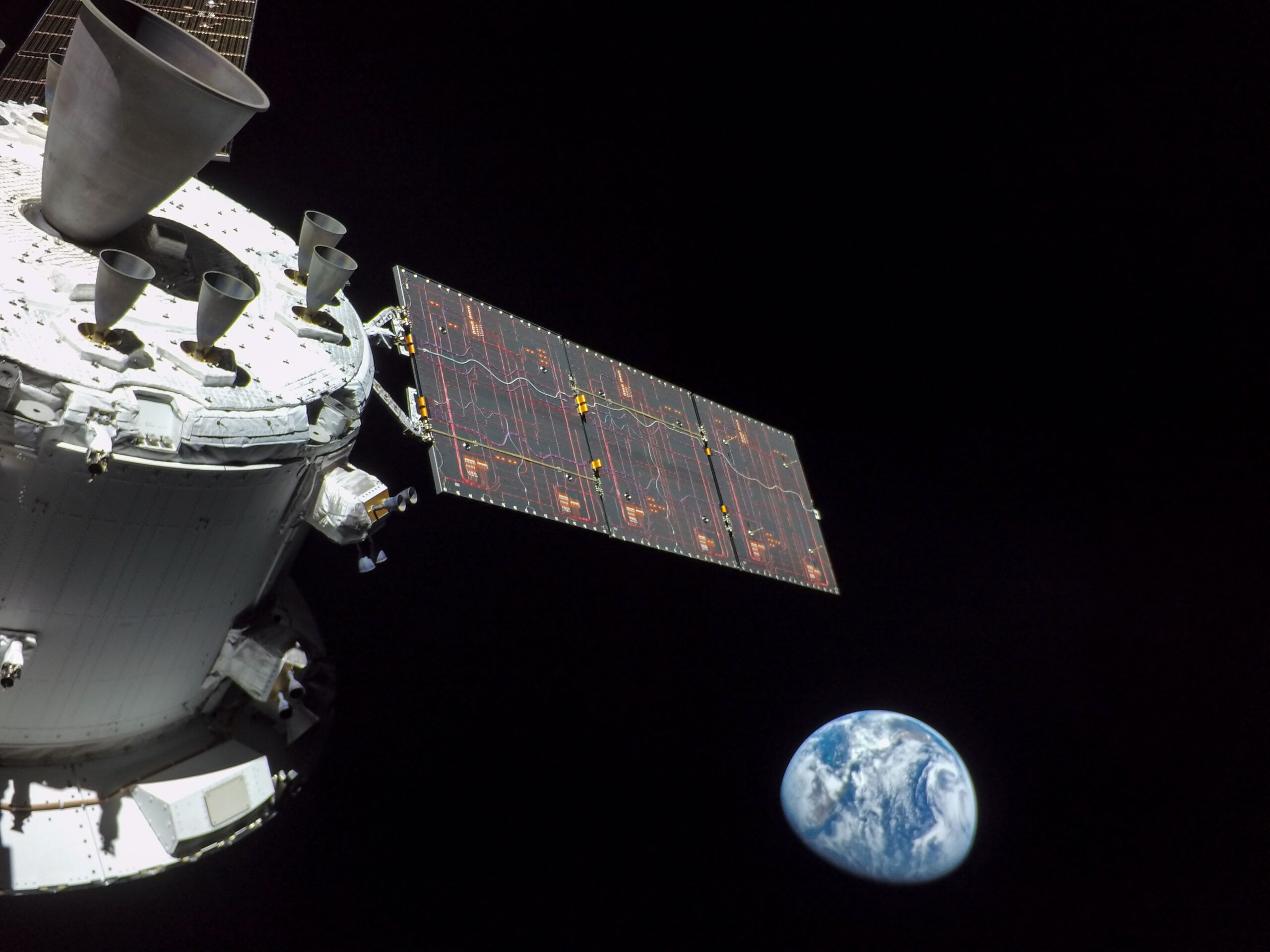
picture shows “art001e000095 FD1 Earth1” – Orion and Earth captured during the Artemis I mission on November 16, 2022.
This first high-resolution image, taken on the first day of the Artemis I mission, was captured by a camera on the tip of one of Orion’s solar arrays. The spacecraft was 57,000 miles from Earth when the image was captured, and continues to distance itself from planet Earth as it approaches the Moon and distant retrograde orbit.
Image Credit: NASA
our latest publications:
-

2026 Global Democracy Coalition (GDC) Forum shows strong interest in developing global democracy
-

Horizon Europe "GoGlobalClimate" project proposal submitted
-

Three CEOs just agreed AI needs to be slowed down. None of them explained who gets to decide.
-
2026 state elections in Saxony-Anhalt show significant demand for global democracy
-

UN officially admits: Reducing burning fossil fuels (coal, oil, gas), meat production (beef, pork) and deforestation failed. It is time to vote.
-

Democracy Innovation – David Campbell extends our latest understanding on democracy
-

Elon Musk wants to "deal out" the global AI governance with his "buddies" from Silicon Valley in a bi-weekly call
-

2026 OPEC "World Oil Outlook" projects 20% increase in global oil demand alongside $17.7 trillion in fossil fuel investments by 2050