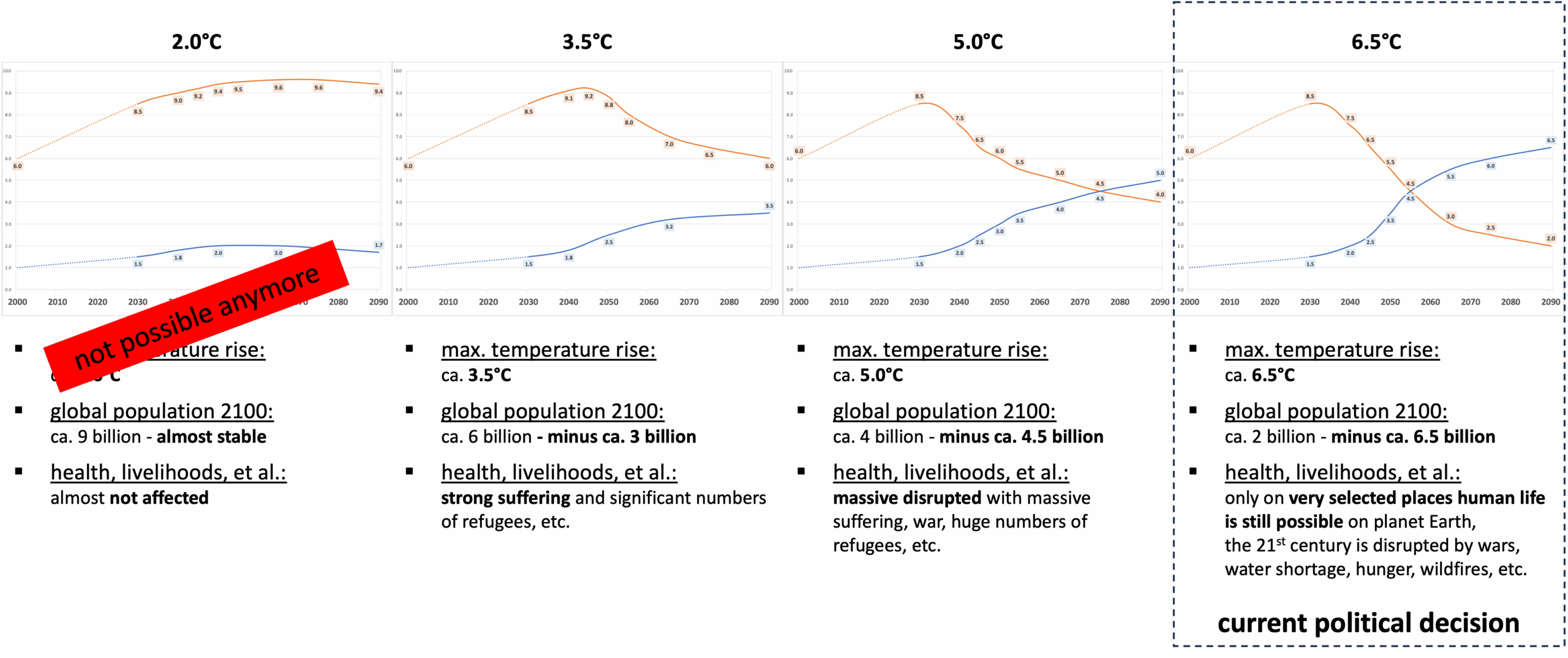
The political decisions made in the next few decades on fossil fuels, the industrial meat production system, and reforestation will not just determine how hot the planet gets, they will determine how many people it can support, and under what conditions. Not in some distant future, but within the lifetimes of people alive today. That is the central argument of a new research article by Karl Baumann and strongly inspired by Ugo Bardi, which establishes direct correlations between global warming trajectories and global population outcomes across multiple scenarios depending on the political choices made between now and 2100.
The Correlations
The research article tracks two variables against each other: the average global temperature rise in degrees Celsius compared to pre-industrial levels (1850–1900), and the expected global population in billions of people. These are plotted across multiple scenarios, each shaped by the political decisions made or not made between now and the end of the 21st century.
The scenarios present a sobering picture. Depending on the degree of political action taken, they map the consequences of those choices on rising temperatures and human population, decade by decade, through to the end of the 21st century.
The Evidence Supporting The Findings
These correlations are grounded in a growing body of research, a.o the 2025 Lancet Countdown on Health and Climate Change, produced by 128 experts across 71 institutions, documented that heat-related deaths have now reached an estimated 546,000 deaths per year. This is evidence that warming is already leading to human mortality at scale.
Xu et al.’s Future of the Human Climate Niche (2020), published in the Proceedings of the National Academy of Sciences, found that between one and three billion people could be pushed outside the climate conditions that have supported human civilisation for the past 6,000 years, a narrow band of mean annual temperatures around 13°C. The paper’s projections directly support Baumann’s correlation between rising temperatures and the disruption of population stability and livelihoods.
Min et al. (2025), in their arXiv preprint on climate-driven mortality risk, modelled the non-linear and lagged effects of climate variables on mortality rates, projecting a long-term increase in total mortality under high-emissions scenarios, further reinforcing the demographic consequences embedded in Baumann’s scenarios.
In The End of Population Growth: Reaching Humankind’s Planetary Limits, a report to the Club of Rome, renowned systems scientist Ugo Bardi, argues that population decline is likely to begin earlier than widely assumed, potentially within the next few decades and that societies must adapt now in order to be prepared for the new trend. His work adds a broader planetary dimension to Baumann’s correlations, reinforcing that demographic trajectories globally are already being reshaped by the limits of earth’s systems.
An Invitation to the Research Community
Having established these correlations and their evidential grounding, Baumann is explicit that this is a “first theory”. He acknowledges that every quantitative methodology is limited and reductive because quality, complexity, system dynamics, language, and emotions can only be measured to a limited degree, and the act of measurement itself intercepts the system it attempts to observe.
For this reason, he makes the call to further this work by collaborating with a plural group of scientists from across research disciplines through the Delphi method.
Baumann believes that human cognitive ability is at its most powerful when connected collaboratively across disciplines and that the most important step in science remains asking the “right questions”.
The research article is therefore both a substantive contribution and an open invitation to protect billions of lives inhabiting our planet.
- Read the full research article:
How Global Warming Will Affect Global Population – A First Theory - Explore IDGR’s ongoing scenario research:
Trans- & Interdisciplinary Global Warming Scenario
latest research papers: