2026 “C3S General Assembly” confirms accelerating global warming due to system dynamics
Karl Baumann,
The 9th “Copernicus Climate Change Service General Assembly” – organised by the “European Centre for Medium-Range Weather Forecasts” (ECMWF) in collaboration with “HungaroMet” (met.hu) and the “Hungarian Meteorological Service” – was held within the well designed “Bálna Honvédelmi Központ” (balnabudapest.hu) in the heart of Budapest, Hungary, from June 3-5, 2026.
The “Copernicus Climate Change Service” (C3S) supports society by providing authoritative information about the past, present, and future climate in Europe and the rest of the world.
“The C3S mission is to support adaptation and mitigation policies of the European Union by providing consistent and authoritative information about climate change. We offer free and open access to climate data and tools based on the best available science. We listen to our users and endeavour to help them meet their goals in dealing with the impacts of climate change.”
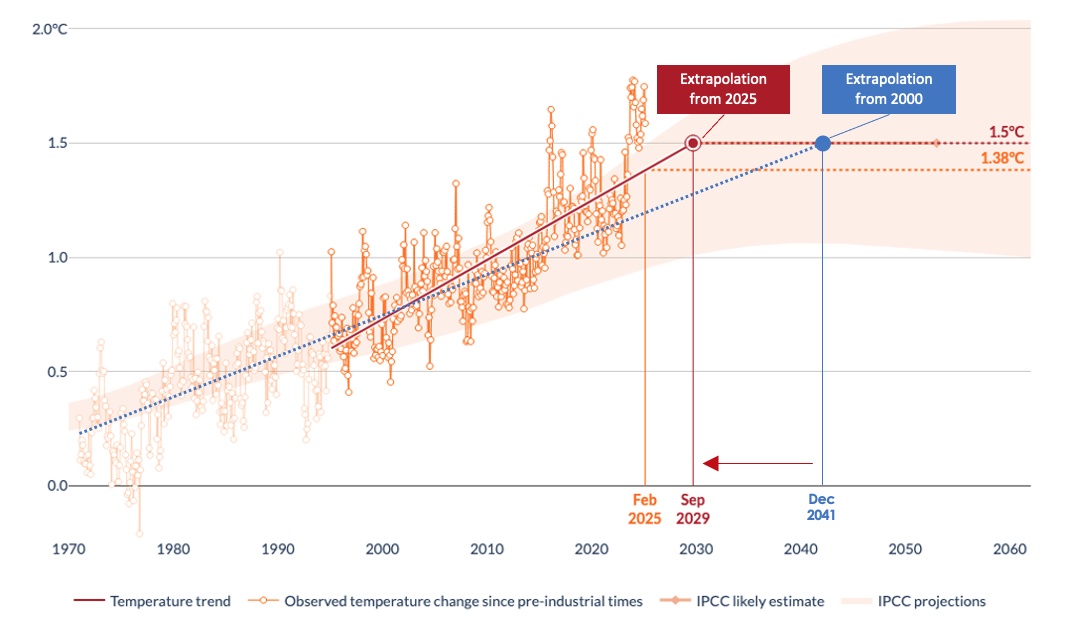
We strongly refer with our work towards the work from C3S, most importantly to the “C3S global temperature trend monitor” and (1) its current projection of reaching the “1.5°C climate tipping point” in January 2029, and (2) its clear data showing an accelerating global warming (cf. the following graph).
The very well organised event gathered together mostly climate scientist with impressive competences and convincing passion towards fully understanding of the climate system from our mother planet Earth.
Out of the presentations, my experience, and many most appreciated and highly valued personal informal talks I had with various speakers and participants, here are the following points I want to highlight:
There is a significant demand for a new attitude towards “climate change” based on “mitigating global warming is too big to fail“.
There is a time gap (cf. e.g. “The Time Lag of Climate Change”, earth.org)- a kind of incubation time – of ca. 30 years between “greenhouse gas” (GHG) emissions and resulting global warming (cf. Karl Baumann 2024: “Temperature rise shows ca. 30 years delay“).
This is worst case for human cognitive abilities, for our political decision-making system (mostly based on 4-5 year election periods), and a very short-term (mostly 2-3 years), profit-driven global business system.
It is essential that we further push the measurement, data collection, data elaboration, and data communication around “greenhouse gas” (GHG) emissions, global warming, and the loss of biodiversity (e.g. via trans- & interdisciplinary global warming scenarios).
The current focus on the correlation between GHG emissions and global warming is too abstract and gives no answer about the actual (regional) impacts on e.g. livelihoods, health, water & food supply, population, and the economy.
Science has done its “job” in providing a clear limit with the “1.5°C global average temperature increase theory” (compared to the global average temperature between 1850-1900, the so call pre-industrial period).
We do have precise data and a clear understanding that we will reach this “1.5°C limit” within about 3 years, sometime around January 2029. There is no possibility – no technology or other means – to stay within this crucial threshold temperature increase, even if we stopped emitting GHG 100% today.
The “climate system” of our wonderful mother planet Earth is one of the most complex (not only complicated) and dynamic systems we as humans every researched and attempted to understand.
State-of-the-art “climate change” science – with all the latest data & technology, “artificial intelligence” (AI) improvements, etc. – is making fantastic progress. Nevertheless, we are far from having a 100% understanding of the “climate system”.
While we understand the basic mechanisms of Earth’s climate system, there remains significant uncertainty about its full behaviour, particularly concerning self-reinforcing dynamics, regional impacts, and long-term consequences.
With all the greatest respect and acknowledgment, out of a humanitarian perspective, there is significant demand for the current ongoing “whitewashing” about global warming to be replaced by honesty, especially within the leading global “climate change mitigating” organisations – the “United Nations”, “United Nations Climate Change” (UNFCCC), and “Intergovernmental Panel on Climate Change” (IPCC).
There is clear evidence that current official publications significantly underestimate the speed and dynamics of global warming.
There is significant pressure from politics on research. Good research strives for truth to the best of our knowledge and conscience. For this, research has to be financially and politically independent in its daily work, decision, and communication.
High ethical standards and ongoing quality assurance rituals assure this noble mission.
With still-rising global GHG emissions and still-increasing deforestation, it is time to clearly admit that politics has failed to keep global warming within a stable and predicable level – the “1.5°C limit”. Now, we are in a situation of unpredictability. This is the worst case scenario for good leadership and successful management.
Global warming is already clearly accelerating. The “1.5°C limit” was always a rough estimate, first introduced by William D. Nordhause in 1975 (cf. e.g. “Can we control carbon dioxide?“).
The balancing cycles that buffer the climate system – mostly oceans, forest, and soil by capturing GHG emission – are full now. Meanwhile, self-reinforcing cycles (e.g. more warming leads to more water vapor in the atmosphere – a potent “greenhouse gas” – triggering further warming, more water vapor in the atmosphere, and so on) are taking over, driving the system toward “system collapse” and a new “stable state”.
The failure to mitigate global warming is a 100% political failure. This political failure is not the issue as long as clear lessons are learned and a (radically) new and successful political approach for mitigating global warming is now being developed with the necessary speed and priority.
“Insanity is doing the same thing over and over again and expecting different results.”
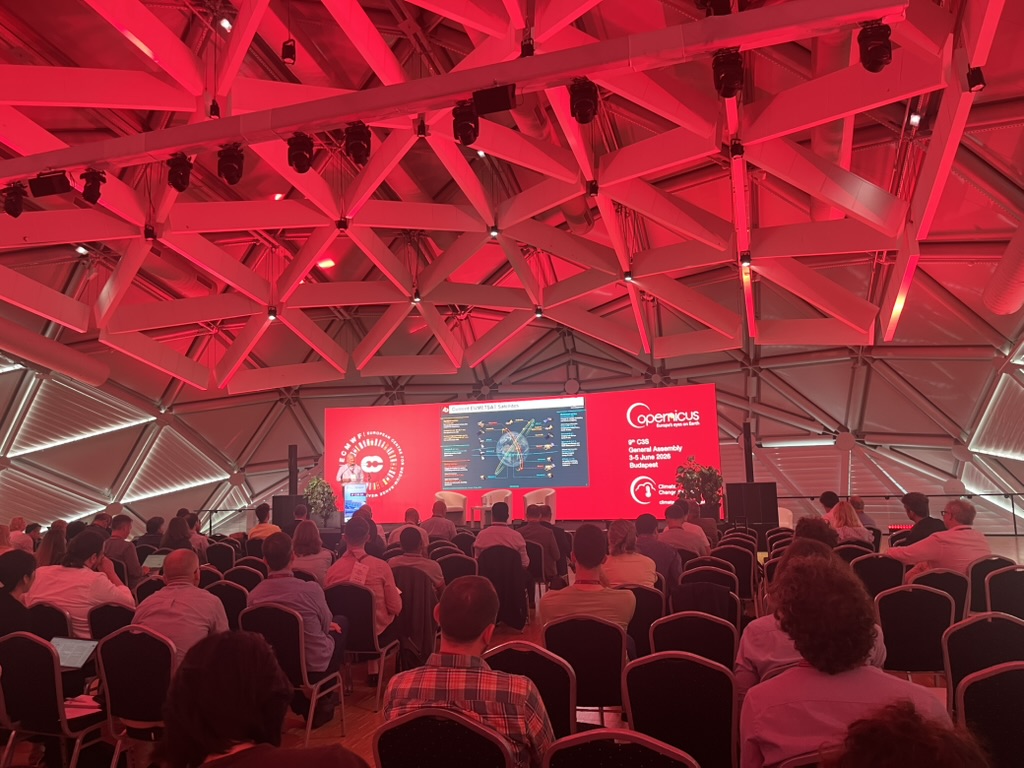
picture shows photo (c) 2026 by Karl Baumann: Scene from a presentation within the main plenary hall during the “9th C3S General Assembly”, Budapest on Friday, June 5, 2026; shot with iPhone 13 mini.
Karl (Head of IDGR) is equipped with years of research around leadership & performance, scenario planning & system dynamics and gained 20+ years of experience in C-level management consulting & organisation development projects.
Since 2019, the development of global democracy is the passion of Karl.
The “Organization of the Petroleum Exporting Countries” (OPEC) published on June 18, 2026 the “World Oil Outlook 2050”. The key message from the report and the presentation: “(…) there is no peak oil demand on the horizon.” In the view of Mr. Al Ghais, the report “offers data driven, transparent,…
There is a delay of about 30 years between “greenhouse gas” (GHG) emissions and actual global warming (see following graph 1), GHG emissions are still raising, and global warming is already accelerating (see following graph 2) – the “1.5°C limit” has always been merely a very rough estimate for the “corridor of human…
As the world observes World Environment Day 2026 (every year on June 5), humanity is no longer discussing global warming, climate change, and the loss of biodiversity as a distant environmental concern. It has become an immediate reality shaping economies, public health, migration, food systems, and political stability across continents….