


Inspired by the fantastic contribution “Climate science is clearer than ever. How should companies respond?” (World Economic Forum, Radio Davos, 2025/08/25), I want to clarify three in my view most important points.
(1) Global warming will accelerate after reaching the “1.5°C climate tipping point”
Most major catastrophes in human history can be explained by “system dynamics” and human cognitive patterns. Within an interrelated system, like the climate system from our mother planet Earth, there are basically two types of cycles – the “balancing cycles” and the “self-reinforcing cycles”. As long as the “balancing cycles” are stronger than the “self-reinforcing cycles”, the system remains in a more or less stable status with linear developments and can be “easily” managed and controlled.
With “self-reinforcing cycles” being stronger than the “balancing cycles”, the system will change exponential and is mostly “out of control”. But our cognitive patterns tend to a “linear projection” (e.g. cf. Baumann, K.: “Organisation der Strategie. Konstruktionen und Dekonstruktionen“, Carl-Auer Verlag, 2005, p. 112ff.) and accordingly the mitigation actions are too weak and too late. This leads to catastrophic developments (last seen e.g. with the “COVID-19 pandemics”).
Within the most complex and most dynamic system of our mother planet Earth, the “climate system”, this means after reaching the “1.5°C climate tipping point” (taking into account that the 1.5°C average global temperature rise is just a rough estimation for the “climate tipping point”), “self-reinforcing cycles” will take over, the temperature rise will be exponential, and global warming will significantly accelerate.
Based on latest data, we will reach the “1.5°C climate tipping point” by May 2029 (cf. “C3S global temperature trend monitor“). So we have to expect accelerated temperature rise after that. The current IPCC scenarios (e.g. cf. “Sixth Assessment Report“) do not take that into account.
And every dynamic system reacts due to the “balancing cycles” – within the climate system that are mostly the cycles including the so called “greenhouse gas” sinks (mainly soil, plants & forests, and oceans) – inert and delayed. With global warming we have a delay between GHG emissions and actual global warming of ca. 30 years (cf. following graph based on “ourworldindata.org“).
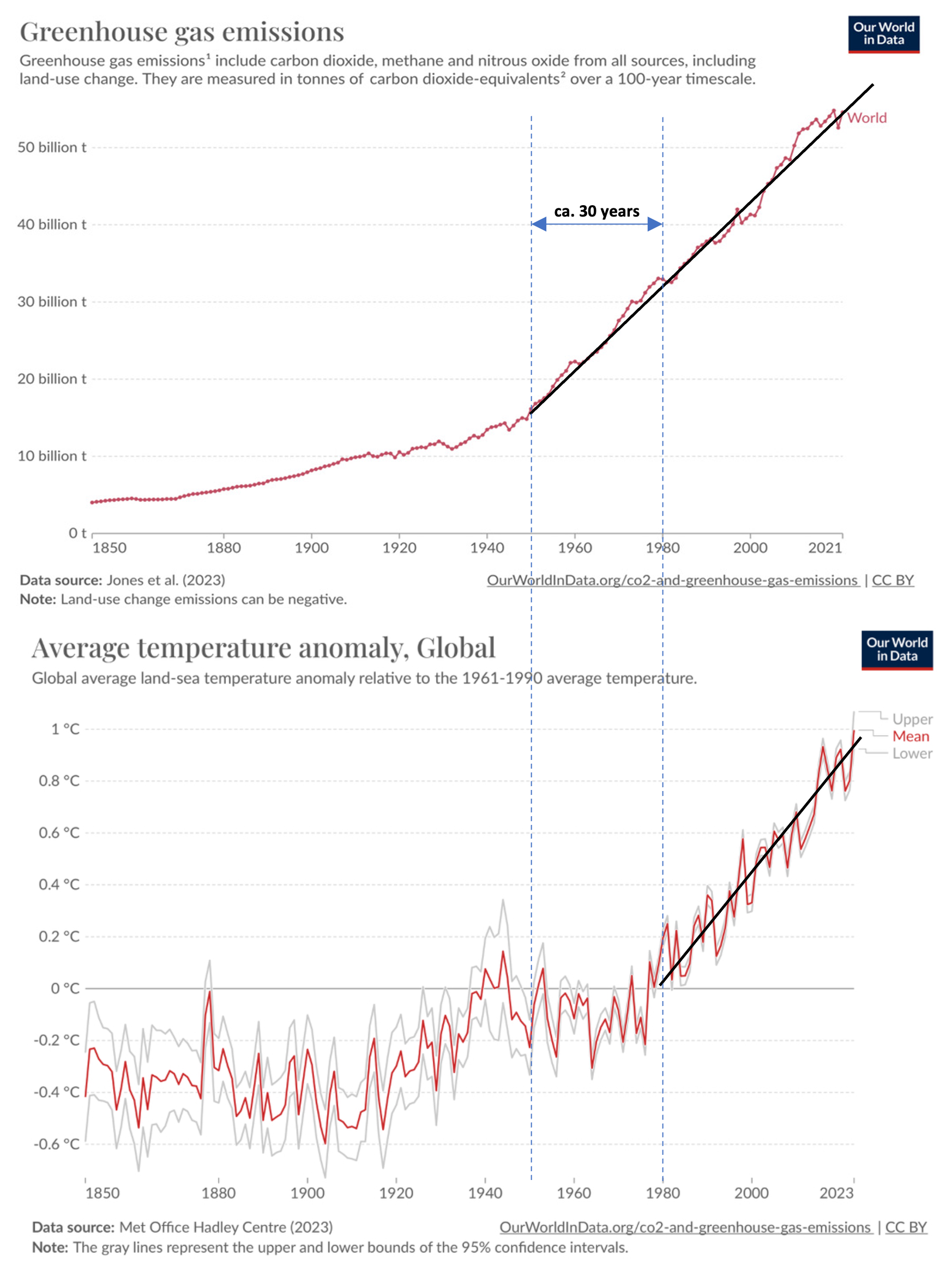
This means the temperature rise we are measuring and observing at the moment, is basically caused by GHG emissions from ca. 30 years ago, so ca. from the year 1995. Since than, the annual global GHG emissions increased from ca. 40 billion t to ca. 55 billion t, this means an increase of ca. 35% or ca. 1/3. Alone based on that we have to expect significant further temperature increase and further global warming.
Furthermore, activated “self-reinforcing cycles” after reaching the “1.5°C climate tipping point” in 2029 will bring the global climate system into a dynamic and much faster development then so far estimated from the “Intergovernmental Panel on Climate Change” (IPCC).
The time gap between GHG emissions and actual temperature rise of currently ca. 30 years will fast shorten, since the GHG sinks are full after reaching the “1.5°C climate tipping point” and the current “balancing cycles” will vanish until new “balancing cycles” can take over and re-stabilise the dynamic global climate system.
In my view, we are currently not able to predict on when and how this is going to happen. So the current view within climate science about “some overshoot for some decades” is most irritating to me.
We pledge for “radical honesty”, which means, we admit, we just do not know, we can not predict anymore. This is the worst case and should automatically lead to fast and decisive mitigation actions, bringing us back to a stable situation where we can predict, at least with some uncertainty.
(2) Mitigating “greenhouse gas” emissions is first of all about fossil fuels and meat production
There is a cure for that fatal dynamic trend: Fast and decisive reduction of global “greenhouse gas” (GHG) emissions. The cause for global warming is the emission of “greenhouse gases” (GHG) – Nitrous oxide (N2O – ca. 5%), Methane (CH4 – ca. 20%), and Carbon dioxide (CO2 – ca. 75%) – into the atmosphere mainly by (1) burning fossil fuels (gas, oil, coal) and (2) producing meat. (cf. graph from “Our World in Data”, https://ourworldindata.org/greenhouse-gas-emissions)

So it is not “only” about phasing out fossil fuels, mostly good to reduce “Carbon” (CO2), which accounts for ca. 75% of global GHG emissions. It is also about significantly reducing meat production, mostly good to reduce Methane (CH4), which accounts for ca. 20% of global GHG emissions.
Reducing Methane emissions by shifting from meat production to a healthy (mainly plant based) nutrition can be a “quick win” with mitigating global warming, since Methane vanishes from the atmosphere much faster than CO2.
(3) Mitigating global warming is 100% within the responsibility of (global) politics
Mitigating global warming is theoretically clear and simple. All what we need is a global binding GHG market based on global GHG emission volumes set by the IPCC. To actually be able to establish this, we first need to establish global democracy. This is the new and potentially successful way towards mitigating global warming and it is “easily” possible.
All we need is the political will to actually do this, to come up with the corresponding decisions within the “United Nations General Assembly” (UNGA) and then the execution of these decisions.
This is not utopian! With the corresponding understanding of global warming and the necessary political will, this can be done within weeks.
Corporations are not and can not be responsible to do that. We can assume, they will fast adapt to stay competitive according to the GHG emissions market.
The responsibility to actually establish this global binding GHG market is to 100% within (global) politics! Science is clear, we need this now.
At the end of the day, this is a political decision about how many people will have to suffer and die due to global warming (cf. “Trans- & interdisciplinary global warming scenario“).
In our view, mitigating global warming is too big to fail.
picture shows sculpture by Hans Arp: The Shell of Venus, 1958;
Städel Museum, Frankfurt am Main (2025/08/08).
our latest publications:
-

2026 Global Democracy Coalition (GDC) Forum shows strong interest in developing global democracy
-

Horizon Europe "GoGlobalClimate" project proposal submitted
-

Three CEOs just agreed AI needs to be slowed down. None of them explained who gets to decide.
-
2026 state elections in Saxony-Anhalt show significant demand for global democracy
-

UN officially admits: Reducing burning fossil fuels (coal, oil, gas), meat production (beef, pork) and deforestation failed. It is time to vote.
-

Democracy Innovation – David Campbell extends our latest understanding on democracy
-

Elon Musk wants to "deal out" the global AI governance with his "buddies" from Silicon Valley in a bi-weekly call
-

2026 OPEC "World Oil Outlook" projects 20% increase in global oil demand alongside $17.7 trillion in fossil fuel investments by 2050