


There is this fundamental misunderstanding from (global) politics, corporations would act in the “common interest”. No. Corporations act to maximise their individual profits and will use all legal possibilities to achieve this goal.
Adam Smith (1723-1790), the “father of capitalism”, was already aware of and very clear about that.
Having worked within most renowned multinational corporations on C-level for many years, I can tell you, the clear task from the C-level board is to maximise the (short-term) profits of their corporation. Performance based payment schemes are very clear about the expected outcome of the C-level work. Not delivering on that expectation means loss of the job.
There might be some discussion about (1) what means “short-term”?
Out of my experience, it actually means something between 3 to 5 years, depending on the strength of a C-level vision and plan. It certainly does not mean 25+ years.
And there also might be some discussion about (2) what means “profit”?
Financial management and performance measurement distinct between concepts like “Net profit”, “Discounted Cash Flow” (DCF), “Economic Value Added” (EVA), “Shareholder Value”, “Return on Investment” (ROI), etc. They all are more or less clear about the basic aim. The basic aim is to become more wealthy, first of all the C-level members and the owners (shareholders) of the corporations.
Everything else is a “means to an end”. And I want to be very clear about that. This is “simply” the clear task of every C-level board out there in every corporation. And they are working very hard and professional day in day out to deliver on that expectation.
So, the task from corporations is very clear and precisely defined. And this task is delivered based on the following principle, as one of the leaders within a multinational told me.
Karl, we will do anything that does not land us in jail.
High Manager within multinational corporation
And no one can blame anyone within these corporations for doing that. This is their clear job, this is what they get paid for. And it is a fundamental misunderstanding mainly within politics and to some extend within (social & economic) science to think about that in a different way.
Managers get paid for maximising profits
The managers within corporations are not doing anything illegal generally speaking, assuming the legal system works. They are also not doing “green washing”. They are satisfying customer demands to maximise profits. This is their very clear task within the given legal systems, within the rules given. And “the market” is “only” as smart as the “customers” within this “market”. Most of these “customers” are “common people”.
If the managers from these corporations want to change the legal system, want to change the rules, you can be sure, this is to improve their potential to maximise their profits. Again, this is nothing they can be blamed for. This is what they are meant to do. This is their job and if they do not deliver on that, they will be fired, immediately.
The core question is, is the maximisation of individual corporate profits within the “common interest”?
The answer is very clear and simple and from Adam Smith never other intended: No. Corporations act and have to act fully in their interest. Once again, to expected something different is a fundamental misunderstanding of the basic concept from a (profit oriented) corporation.
Coal, gas, and oil producing companies can not be blamed for what they do
It is the very clear task of politics to create sustainable legal framework conditions! No corporation out their, also not the coal, gas, and oil producing companies can be blamed for what they do. Because everything is so far within the (local and global) legal frame.
It is 100% task and responsibility from politics to develop a (legal) framework, which assures a sustainable (global) economy within the know healthy “planetary boundaries” clearly and precisely delivered by science. Within this context, it could not be more failed when it comes to fossil fuels (coal, oil, gas), staying within healthy “planetary boundaries” and (global) politics.
“The Organization of the Petroleum Exporting Countries” (OPEC) intends and sees the need to increase the global fossil fuel production. For OPEC the global increasing energy demand mainly due to population increase and lifestyle development means first of all a market opportunity. There is a demand for energy and they have a product (coal, gas, oil) to satisfy this need by selling their products and by doing this optimised, they can maximise their rentability and profits.
“OPEC’s World Oil Outlook forecasts that until the year 2050 a cumulative $17.4 trillion in oil investments alone would be required to ensure that demand is sufficiently met.”
9th OPEC International Seminar, seminar.opec.org/programme-2025
At the same time, the “United Nations”, especially “United Nations Climate Change” (UNFCCC) talks about facing out fossil fuels (ca. 65% of global GHG emissions come from burning fossil fuels) and the need for a reduction of ca. 40% of global annual “greenhouse gas” (GHG) emissions within the upcoming 5 years, till the end of 2030, and minus ca. 80% within the upcoming 25 years, till the end of 2050. (see the following graph)
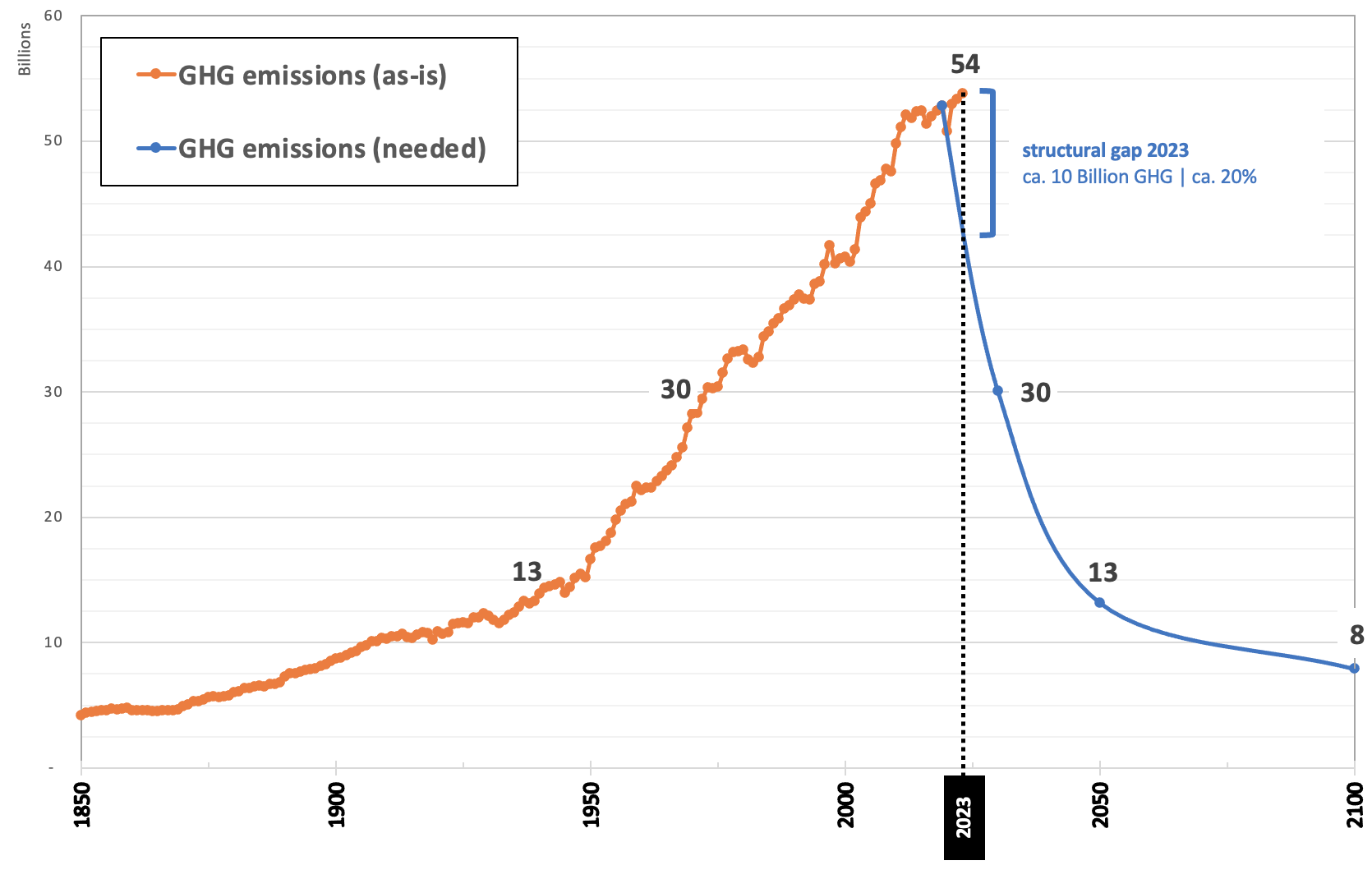
(Global) Politics failed to mitigated global warming and reduce “greenhouse gas” emissions accordingly
With all the greatest respect and acknowledgment, in our view, it is time to acknowledge, the “UN COP Process” from UNFCCC to mitigate GHG emissions according to the “planetary boundaries” failed and there is no reason to think, this will change or there will be some “miracle” happing within the upcoming COP30 in Brazil. Coal, gas, and oil companies will certainly not regulate themself away from (short term) profit maximisation. They will use their assets as long as possible according to the best “Return on Investment” (ROI) for these assets, and according to the (local and global) legal framework and governance.
Not reaching a goal is not the issue. Not reflecting, not learning, and not changing the current approach to reach this goal based on the “lessons learned” is the issue. “Radical honesty” is necessary within this learning process for successful change. “Radical honesty” within the analyses of the situation, the reflection of cognitive abilities, the radical critic of the current structures and processes, and fearless creativity for the development of new, better, and actually performing & delivering solutions.
We need a radical shift within global political decision making towards global (direct) democracy
In our view, we need now a radical shift within global governance and global political decision making towards global (direct) democracy. We have got all the needed communication technology, ca. 5.5 billion people are connected to the internet today. This is just a fantastic opportunity for actual change towards a healthy and thus sustainable planet Earth.
To deliver on that is 100% within the responsibility of (global) politics, not corporations. The fast majority within science is very clear and precise, for many, many years already. And with the appropriate political will, this can be done within months with relatively little “costs” (investment) and historic impact.
Let us be brave and let us make radical and most likely historic change and organise a first global direct democratic vote on “climate actions” now.
If anything, mitigating global warming, climate change, and the loss of biodiversity is too big to fail!
picture taken from seminar.opec.org/gallery (2025/07/27).
our latest publications:
-

2026 Global Democracy Coalition (GDC) Forum shows strong interest in developing global democracy
-

Horizon Europe "GoGlobalClimate" project proposal submitted
-

Three CEOs just agreed AI needs to be slowed down. None of them explained who gets to decide.
-
2026 state elections in Saxony-Anhalt show significant demand for global democracy
-

UN officially admits: Reducing burning fossil fuels (coal, oil, gas), meat production (beef, pork) and deforestation failed. It is time to vote.
-

Democracy Innovation – David Campbell extends our latest understanding on democracy
-

Elon Musk wants to "deal out" the global AI governance with his "buddies" from Silicon Valley in a bi-weekly call
-

2026 OPEC "World Oil Outlook" projects 20% increase in global oil demand alongside $17.7 trillion in fossil fuel investments by 2050
