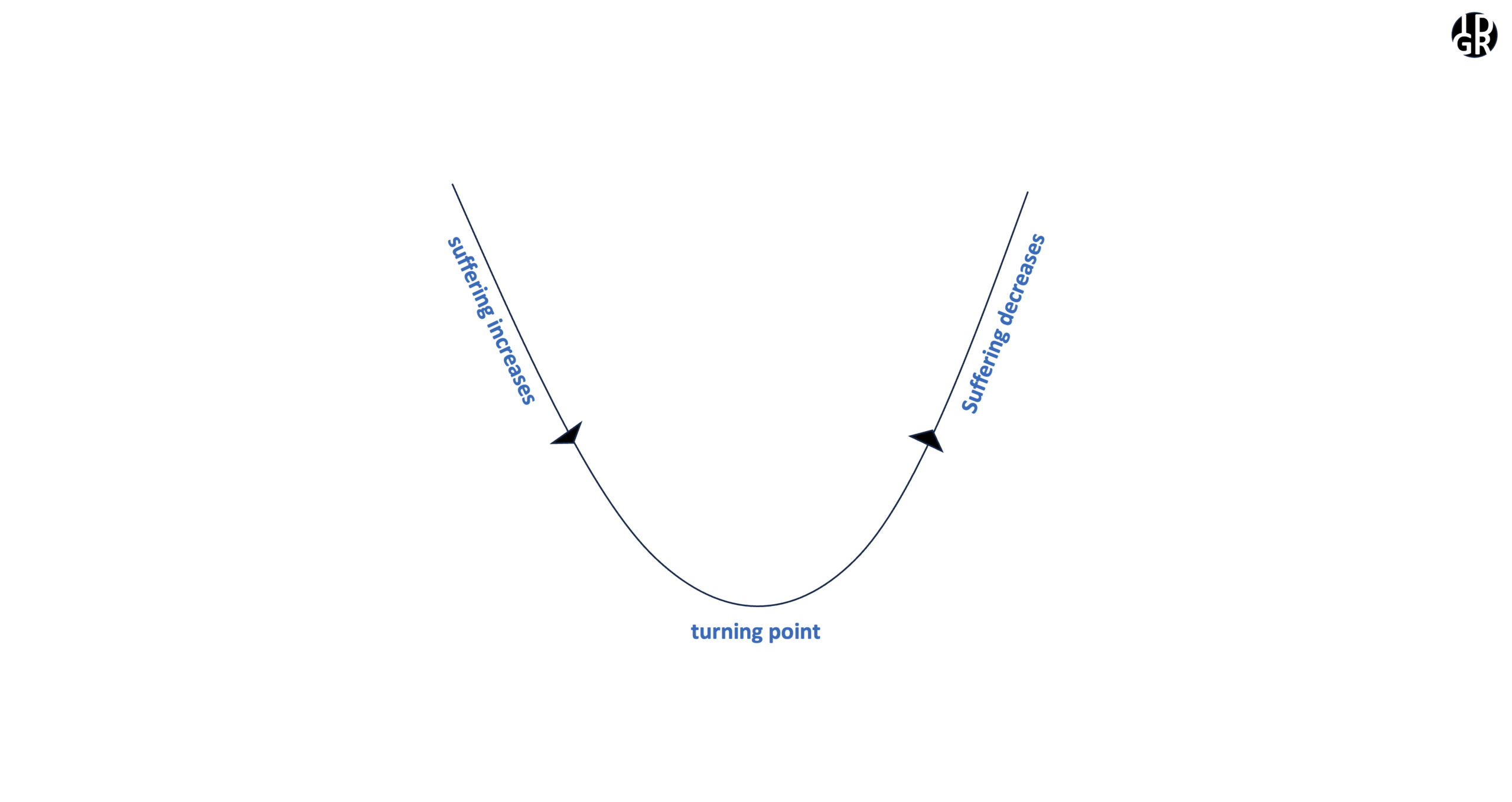
(I.1) Listing and Hearing: the more you listen, the less you hear.
(I.2) Watching and Seeing: the more you watch, the less you see.
(I.3) Tasting and Enjoying: the more you taste, the less you enjoy.
(I.4) Touching and Feeling: the more you touch, the less you feel.
(II.1) Protecting and Supporting: the more you protect, the less you support.1
(II.2) Thinking and Doing: the more you (have to) think (of), the less you do (it).
(II.3) Knowing and Believing: the more (you think) you know, the more you believe.2
(II.4) Acting and Performing: the more you act, the less you perform.3
(II.5) Possessing and Controlling: the more you possess, the less you control.4
(II.6) Socialising and Criticising: the more you socialise, the less you (are able to) criticise (and innovate).
(II.7) Competing and Collaborating: the more you compete, the less you (are able to) collaborate.5
(II.8) Growing and Changing: the more you grow, the less you change.6
(II.9) Owning and Having: the more you own (it), the less you have (it).7
(II.10) Leading and Designing: the more you lead, the less you design.8
(II.11) Dominating and Loving: the more you dominate, the less you love.9
(II.12) Evaluating and Creating: the more you evaluate, the less you create.10
(II.13) Commercialising and Shaping: the more you commercialise, the less you shape.11
(II.14) Living and Dying: the more you live, the less you die.12

(III) Do you hear the silence? – By finding the patterns of paradoxes, we want to develop the best possible theory about social order. This may sound absurd or contradictory or even insane to most of you. We may view it as the foundation for the development of a healthy and thus sustainable society based on global democracy.
Footnotes
- e.g., Protection and Destruction: the more you protect, the more you destroy possibilities. ↩︎
- e.g., Learning and Feeling: the more you learn, the more you can, the less aware you are of what you can. This may lead into depression or burn out. ↩︎
- e.g., in terms of persistency. ↩︎
- e.g., Possession and Erotic: the more you possess and control, the less erotic it/she/he is. ↩︎
- e.g., Competition and Nationalisation: the more an organisation grows, the more an organisation gains market share, the more likely is the loss of ownership by Nationalisation of the organisation (in bad times). ↩︎
- e.g., Growth and Change: the bigger an organisation, the less flexible is an organisation. ↩︎
- e.g., Capitalism and Socialism: the more someone wants to own the more she/he has to invest. ↩︎
- e.g., Leadership and Abstraction: the more leadership responsibility, the higher within a hierarchy, the less operational and creative power. ↩︎
- e.g., Leadership and Friendship: the more you lead, the more you have to dominate as a sadist, the compensation and pleasure comes from being devote as a masochist. ↩︎
- e.g., Evaluation and Creation: the more you evaluate, the more you standardise around the best results, and the less you create unknown, experimental services/products/theories. ↩︎
- e.g., Commercialisation and Ethics: the more you want to sell of a certain service/product, the more mimetic desire (greed, vanity, envy, jealousy, group-think) the service/product has to create – which might be a creative process in itself but the result (monotone consumption behaviour – “all” buy the same service/product) destroys individual plurality and creativity. ↩︎
- e.g., Life and Death: the more creative acting while you live, the more loss when you die. ↩︎